

You have a product idea that could shave hours off someone’s workweek or unlock a brand-new revenue stream. Yet calendars move fast, and investors expect traction even faster. Recent data show that the median time from Seed to Series A has lengthened compared with historical norms. For example, Carta and other venture funding analyses indicate that the median interval between Seed and Series A has risen to over 2 years in 2024 and 2025, reflecting a slower progression for many startups as investors demand stronger metrics and more runway before investing in Series A. In that world, deciding whether to build everything in-house or bring in specialists is about far more than code; it is about odds of survival and eventual category leadership.
Below we unpack seven core reasons to team up with a dedicated SaaS crew, add three deeper dives into DevOps, and finish with a forward-looking framework for keeping momentum.
- The Race Against the Clock: Why Speed Still Wins

Shipping first is no guarantee of winning, but shipping late almost guarantees struggle. External specialists arrive with proven scaffolding user onboarding flows, billing hooks, and CI/CD pipelines, so your sprint plan starts on square three instead of square zero. That head start buys critical weeks for refinement while competitors are still assembling the basics.
List of common accelerators:
- Prebuilt authentication with social logins and SSO.
- Infrastructure-as-code scripts that spin up staging, QA, and production in under an hour.
- Feature-flag frameworks are wired for instant rollback on error thresholds.
- A library of UI components already harmonized with your brand tokens.
- Playbooks for phased rollout: alpha, private beta, public beta, that match investor milestone language.
Those weeks compound. Every early release cycle gives you feedback, testimonials, and credible metrics to mention on your next investor call. Save enough of them, and you move from “promising” to “category front-runner” before anyone notices.
- Deep Architecture Matters
Re-architecture is the second-biggest cost on most SaaS P&Ls, right after salaries. A seasoned SaaS development company prevents that bill by laying the correct foundations on day one. Data isolation, tenant-aware encryption, idempotent billing, and audit trails all sound abstract until an enterprise prospect puts them in a questionnaire. Get them wrong, and the fix is never quick, cheap, or quiet.
Many young teams mount every tenant on a single database schema “just until PMF.” Six months later, compliance demands tenant-level keys, and every query must be rewritten. Consultants who have solved that riddle for fintech and health tech refuse to start with shortcuts that turn into landmines.
Structural wins you bank early:
- Encryption keys are segmented by tenant, so a single breach never grows into a catastrophe.
- Billing webhooks that remain idempotent even when Stripe retries, protecting revenue.
- Usage-metering pipelines ready for by-seat, by-event, or hybrid pricing.
- Audit-logging patterns aligned with SOC 2 controls.
- Plugin-based integration layers, allowing new connectors to be added in days, not quarters.
With those pieces in place, your startup already looks like it belongs among top SaaS providers, and prospects stop asking whether you can scale – because the architecture answers for you.
- Learning from the Field: Playbooks Borrowed from Top SaaS Startups
No one has time to reinvent every wheel. Agencies that rotate across verticals soak up what works at top SaaS startups and discreetly pass those lessons forward.
Imagine your team is debating whether to require a credit card at sign-up. Your gut says yes; growth threads on social say no. A consultancy that ran A/B tests across five products in the last year can show you the actual lift and churn numbers, ending the debate in a single meeting.
Cross-pollinated tactics worth stealing:
- Onboarding “aha!” moments surfaced within three clicks, proven to cut day-7 churn.
- Tiered usage-plus-feature pricing that drove net revenue retention above 130% for a logistics platform.
- Viral referral hooks triggered at workspace-level milestones faster land-and-expand than user-level prompts.
- Self-serve demo environments that auto-reset nightly, a trick first seen in top SaaS startups serving developers.
- Admin dashboards that surface ROI metrics customers can repeat to their bosses during renewal season.
Borrowing these playbooks narrows the gap between you and a top SaaS platform competitor without copying their features feature for feature. Investors notice the sophistication, and customers feel like they are buying from an outfit that has done this before.
- Dollars, Sense, and Elastic Teams
External help is not automatically cheaper, but when you tally recruiting, equity dilution, onboarding, churn, and tool licenses, the math tilts toward elastic teams. A security engineer making $190 k also needs benefits, a laptop, ramp-up time, and stock options. If you need that skill two months per year, renting beats owning.
Cost sinks you sidestep:
- Idle salaries when priorities shift.
- Hefty SaaS subscriptions for observability or design tools are already bundled in the vendor fee.
- Replacement costs when a senior dev quits two weeks before launch.
- Legal and HR overhead for hiring in multiple regions.
- Opportunity cost of founders interviewing instead of selling.
Variable cost structures stretch the runway when markets wobble. Seasoned investors love to see them in early-stage decks because they signal discipline and resilience characteristics shared by many top-growing SaaS companies.
- Compliance, Security, and Trust as Day-One Features
Regulators ignore your size. GDPR, CCPA, HIPAA – pick an acronym – apply whether you serve ten users or ten thousand. A focused partner embeds compliance from the first commit, not as a patch after a scary email.
By the numbers: Attackers do not wait for a startup to grow up: exposed cloud workloads were attacked on average just 5.3 hours after being exposed, according to the Microsoft Digital Defense Report 2026.
According to Verizon’s 2025 Data Breach Investigations Report, vulnerability exploitation jumped 34% and now accounts for about 20% of breaches, underscoring how misconfigured and unpatched systems are targeted by attackers. Consulting teams that lock down least-privilege defaults from day one close that door long before your first security questionnaire appears.
Controls every modern SaaS should launch with:
- Infrastructure-as-code templates built on CIS-hardened images.
- Automated secrets rotation every 90 days.
- Continuous vulnerability scanning merged into the pull-request flow.
- One-click production backups with cross-region redundancy.
- Incident-response playbooks mapped to ISO 27001.
Choosing Bright Defense cybersecurity compliance services supports your SaaS organization with a secure, audit-ready foundation that protects against evolving threats.
When your sales deck shows the same trust posture as top SaaS software for business, procurement cycles shrink, and price sensitivity fades.
- DevOps, Cloud, and Observability – Your Hidden Growth Engine
Operations rarely hog headlines, yet uptime and performance quietly govern churn. Outages push customers toward competitors faster than missing features ever will. External crews that oversee dozens of pipelines spot anomalies quicker than any single-product team can.
They also know which AWS Graviton instance provides 20% more throughput for Node workloads or how to combine CloudFront with Regional Edge Caches to slash latency in APAC without exploding cost. Those optimizations let you punch far above your weight, so customers compare you favorably with top SaaS providers they already trust.
Cost-Smart Cloud Footprints
Cloud invoices grow like weeds when no one owns optimization. Veteran DevOps engineers come armed with dashboards that flag waste on day one.
Savings levers they pull early:
- Rightsizing instances with real-time utilization metrics.
- Converting steady workloads to savings plans or reserved instances.
- Offloading bursty workloads to spot fleets with safe interruption handling.
- Turning on storage-lifecycle rules that auto-archive cold data to Glacier.
- Automating nightly environment shutdowns for demo and QA systems.
Those cuts commonly reduce the bill by 30-40%, allowing it to invest in growth experiments without hindering roadmap momentum.
Automated Resilience at Scale
Previously, reliability engineering was a luxury; today, it has been transferred to buyers. Consultancy bakery, circuit breakers, and chaos drills into the initial sprints are baked to ensure the frequency of the incidents remains at low levels despite increasing traffic.
Key resilience techniques:
- Health-based load balancers with auto-isolation for unhealthy containers.
- Database replicas are configured for failover in sub-minute windows.
- Canary releases are fed by automated rollback policies on error spikes.
- Regional redundancy with DNS failover to keep SLAs intact.
- Chat-ops tooling that lets engineers remediate from mobile during off-hours.
Result: When a top-growing SaaS company tweets about a 30-minute outage, your status page stays green, and prospects remember.
Actionable Observability for Everyone
Data without context is noise. Effective observability means any engineer, PM, or support rep can trace a user’s bad experience to a root cause in minutes.
Components you get out of the box:
- Unified logging pipelines enriched with tenant and request IDs.
- Distributed tracing that links front-end clicks to back-end microservices.
- Real-time alerting tuned to customer-impact thresholds, not generic CPU alarms.
- Business-level dashboards (e.g., sign-ups per minute) live beside system graphs.
- Post-incident trend reports that feed directly into backlog grooming.
That visibility accelerates learning loops and keeps cross-functional teams aligned, one reason top SaaS software for business feels responsive even under stress.
- A Partner for Every Growth Stage
Version 1 is merely the opening act. Over the next 24 months, you will add APIs, refine pricing, and perhaps enter a second market. A retained partner acts as a fractional CTO, feature squad, or architecture historian depending on what tomorrow demands.
Continuity avoids the dreaded “bus factor.” When a founding engineer leaves, context does not evaporate. External architects keep diagrams, runbooks, and trade-off memos on hand so newcomers ramp quickly and investors stop worrying.
Looking forward, a good partner also scans the horizon. If OpenAI drops a cheaper embedding API or Stripe adds native usage-metering, you hear about it in a weekly stand-up, not on X a month later. Early adoption keeps your roadmap fresh and positions you alongside a top SaaS platform known for relentless iteration.
From Launch to Market Leader: Tactical Next Steps
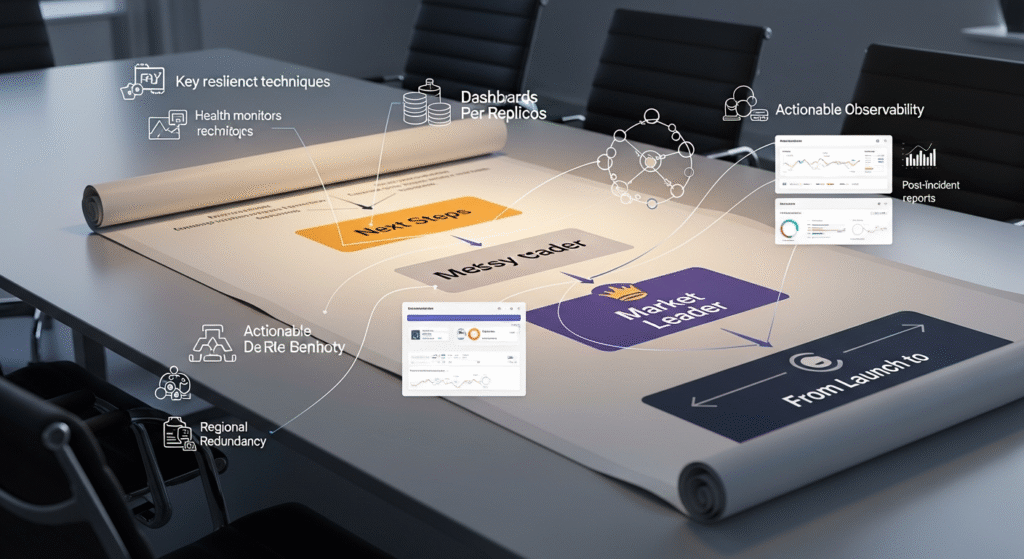
Momentum after launch is fragile. Below are three focus areas, each a short subsection, that help founders turn early traction into durable dominance.
Data-Driven Roadmapping
Intuition got you to version 1; structured data takes you further. Hooking product analytics into your core database exposes usage clusters, dead-end flows, and upgrade signals.
Questions a data-savvy PM asks weekly:
- Which features correlate most with renewal likelihood?
- Where do trial users stall before activation?
- How does usage depth change after a price increase?
- Which integration drives the highest expansion revenue?
- What UI events predict an upcoming churn ticket?
Answering them turns roadmap debates into evidence-based prioritization and aligns engineering effort with revenue goals.
Customer Success Loops
Success is not a department but an every-sprint attitude. The first step is to plot every milestone of customer onboarding, first value, and expansion, and synchronize internal activities to those beats.
Core loops to institutionalize:
- Kickoff 24 hours after signing contracts.
- The time when NPS surveys are conducted is not random, but at the so-called aha! moment.
- Business reviews centered on the ROI measures, not feature show-and-tell on a quarterly basis.
- Usage-based in-app notifications.
- Alerts about churn-risks were brought to light to founders, and weren’t lost in the CRM nois.
These practices build the advocacy flywheel that powers most top-growing SaaS companies.
Continuous Pricing Experiments
Pricing is never “set.” The market shifts, costs fall, and new competitors emerge. Adopt a habit of lightweight experiments, measured and iterated like features.
Levers to test:
- Hybrid seat-plus-usage tiers vs. pure usage.
- Annual discounts tied to roadmap co-creation.
- Premium support bundles are priced based on the percentage of spend.
- Region-specific list prices aligned to purchasing power.
- Built-in upsell prompts after reaching usage thresholds.
Running two small pricing tests each quarter can lift ARR more than shipping another minor feature.
After implementing these three focus areas, teams often see retention rise and lifetime value deepen, yet another signal to the market that you belong among the top SaaS providers.
Conclusion
Choosing an external SaaS team is no silver bullet, but it can compress timelines, harden your stack, and free founders to obsess over customers. Speed, robust architecture, proven playbooks, variable costs, baked-in compliance, mature DevOps, long-term continuity, and disciplined post-launch tactics together, these advantages position you to challenge incumbents and maybe join the ranks of a top SaaS platform yourself.
If the goal is category leadership, partnering early with specialists who have walked the path repeatedly may be the smartest first sprint. You will move faster, sleep better, and tell a richer story the next time an investor asks, “Why will you win?”
Related reading
