

Grokipedia, founded by Elon Musk, is an AI-guided encyclopedia that serves as a new competitor to Wikipedia.
Since its inception, Grokiopedia has developed a reputation for providing a fresh perspective on knowledge by combining AI effectiveness with the assistance of volunteers in various parts of the world. That is to say, Grokiopedia is a source that continually builds and provides reliable and current knowledge to anyone visiting the site.
What Is Grokipedia?
At the end of October 2025, the artificial intelligence company that Elon Musk has started, xAI, officially released its latest project, which is Grokipedia.
Version 0.1 was released on October 27, 2025, marking the debut of an AI-driven encyclopedia designed to “pursue truth and nothing but the truth.”
Grokipedia, as announced by xAI, will compete directly with Wikipedia, which Musk has personally criticized for its left-leaning bias.
He describes Grokipedia as a platform focused on objectivity, integrity, and factual accuracy, promising to eliminate what he calls “propaganda.”
At launch, Grokipedia reported approximately 885,000 English-language articles, or “over 800,000” according to multiple outlets.
In comparison, English Wikipedia hosted more than 7 million entries at the same time, meaning Grokipedia started at roughly 12% of Wikipedia’s scale.
How Grokipedia Works

Source: Grokipedia
AI-Generated, Not Community-Edited
Grokipedia and Wikipedia operate in an entirely different fashion. Whereas Wikipedia’s model is crowd-sourced, allowing volunteers around the world to create or edit articles, Grokipedia content was generated, curated, and maintained by Grok, the AI chatbot developed by xAI.
In their white paper, xAI stated, “Grok is designed to provide accurate and up-to-date information with reduced errors and bias” and highlighted the centralized control of Grokipedia’s content. Users cannot edit pages directly, only submit error reports or interact with a small pop-up for feedback when using the platform.
The centralization of Grokipedia allows for consistently accurate information based on AI-driven principles, but this definition of content accuracy stands in stark contrast to Wikipedia’s more open and decentralized model, reflecting the collective participation of the community and a consensus for information.
Reusing Wikipedia Content
Numerous Grokipedia pages state that they borrowed content from Wikipedia, complete with a note like, Adapted from Wikipedia, licensed under CC BY-SA 4.0. This implies that some of the encyclopedia is obtained from open-source content on Wikipedia.
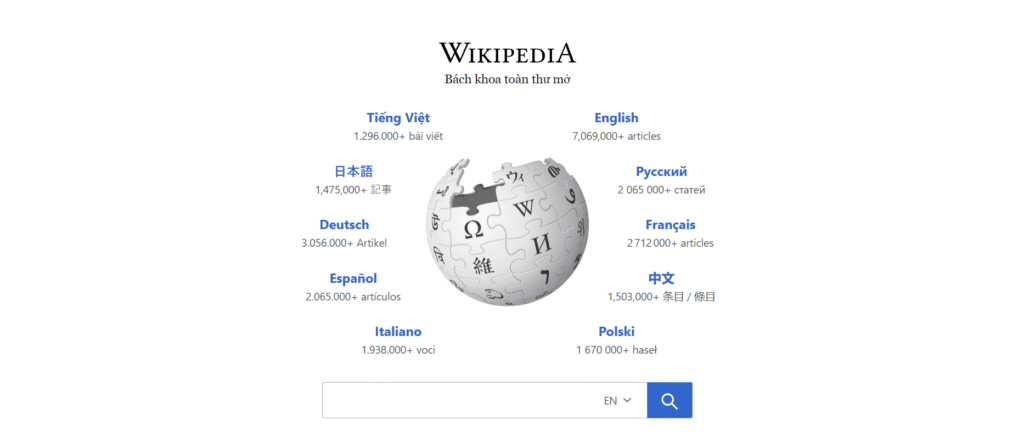
Source: Wikipedia
Nonetheless, as mentioned by such sources as The Verge and Wired, the text in most cases is nearly another copy of the original Wikipedia articles, casting doubt on the originality and intellectual autonomy of the content of Grokipedia.
Although the attribution is licensed as required, according to the critics, the overuse of Wikipedia can cause confusion between AI-produced knowledge and recycled human-edited information, which raises questions about the authorship, creativity, and responsibility of AI-mediated platforms.
Interface and Design
The site of Grokipedia has a simplistic design, with a huge search box and a simple white layout that reminds one of olden day Wikipedia. At the moment, the platform is only available in English, but xAI has indicated that multilingual expansion is on the cards in future releases.
The label of Fact-checked by Grok can appear in each article, which means an attempt to guarantee accuracy, but the process of verification is not revealed, and the readers cannot be sure of how the facts are verified in practice.
The Vision Behind Grokipedia
To achieve this goal of factual accuracy, Grokipedia is shifting how knowledge is created and managed online.
“Truth, Integrity, and Nothing but the Truth”
Elon Musk said Grokipedia’s objective is to ensure factual accuracy and objectivity in online knowledge. He believes platforms like Wikipedia historically demonstrate editorial bias through the ideology of the volunteer editors.
By using Grok’s AI models, trained on xAI’s proprietary data and social interactions on X (formerly Twitter), Grokipedia delivers AI-curated truth without political bias.
Centralized Knowledge Creation
This project is a transition from an open-collaborative model like Wikipedia to a centralized, AI-driven knowledge database. Rather than encumbering thousands of human editors with the burden of conflict and debate during revisions, Grokipedia will use one system, Grok’s neural model, to determine the validity or fact of knowledge.
Criticism and Controversy
However, Grokipedia’s approach has faced growing criticism over bias and transparency.
Content Accuracy and Bias
Since its launch, Grokipedia has been chided for its political bias and scientific inaccuracies. Wired and The Times of India have reported that some articles, e.g., those on gender identity or climate change, use text that aligns with conservative viewpoints, in contrast to Wikipedia’s more neutral language.
Copyright and Attribution
The Verge observed that many Grokipedia pages are near-copies of Wikipedia content, albeit legally allowed under the CC BY-SA 4.0 license.
However, this stirred up conversations on whether Grokipedia adds any new forms, language, or imagination to the ideas or simply re-constructs AI formats of Wikipedia.
Lack of Transparency
A related issue is the lack of transparency in their fact-checking system. While some articles indicate they are “Fact-checked by Grok,” xAI has yet to explain to users what Grok does to fact-check a claim, whether it references other sources, uses language modeling, or employs human editors.
Response from Wikimedia Foundation
The Wikimedia Foundation, the organization behind Wikipedia, released a statement indicating that they are a community-based, nonprofit platform. It emphasized that Wikipedia’s transparency based on open edit history and peer review is what allows the site to be trustworthy over time.
By contrast, Grokipedia’s centralized AI moderation is still untested and opaque.
Why Grokipedia Matters
Grokipedia goes beyond being simply another online reference source; it represents how AI is changing the definition of truth.
In a society saturated with misinformation, the prospect of an AI sourcing, organizing, and updating facts is both thrilling and frightening.
Assuming it works, Grokipedia could:
- Transform how we access verified information
- Alleviate bias from human editing
- Establish AI-based trust systems for a knowledge repository.
However, the challenge lies in proving that AI bias is not just replacing human bias with something harder to detect.
Future Outlook
Looking ahead, Grokipedia’s future hinges on how it balances rapid expansion with public trust.
Growth Potential
With xAI’s resources and integration into Musk’s ecosystem (X, Tesla, SpaceX), Grokipedia could rapidly expand, potentially hitting millions of entries in its next versions.
Its AI foundation allows for instant updates, meaning it could one day become a real-time knowledge graph that stays constantly up to date.
Barriers Ahead
But growth will depend on trust.
Without transparency, Grokipedia risks being seen as an ideological project, not a factual reference.
Moreover, its heavy dependence on AI makes it vulnerable to hallucination errors, a well-known issue in generative models.
Should You Use Grokipedia?
For the time being, Grokipedia should be viewed as a secondary reference source. The contents are fun for quick summaries, but are not yet a good source for citations or scientific studies. Users should verify the information with sources like Wikipedia, academic sources, or other well-supported sources before quoting.
However, Grokipedia may be a useful tool that illuminates how AI is thinking about “truth,” a concept that is already changing rapidly due to generative AI.
Conclusion
Grokipedia represents a bold experiment, merging artificial intelligence with human knowledge curation.
It challenges the decades-old Wikipedia model by replacing human editors with algorithms, aiming for pure factual integrity.
Yet, as of now, Grokipedia remains in its infancy, version 0.1, with fewer than one million articles, unclear verification standards, and a centralized AI editing system still under scrutiny.
The project raises a crucial 21st-century question: In the age of AI, who decides what’s true: the crowd or the code?
Only time will tell whether Grokipedia becomes a credible rival to Wikipedia or just another experiment in the AI information revolution.
Frequently Asked Questions