US advertisers are forecast to spend $44 billion on creators in 2026, up from $29.5 billion in 2024, according to IAB. In Influencer Marketing Hub’s 2026 survey, 87.49% of marketers expected their influencer budgets to rise, and 72.22% expected increases of 50% or more. Trust is the weak point: only 5% of US consumers fully trust influencer content.
The influencer marketing statistics below cover spending, budgets, ROI, platforms, creator pay, AI and consumer trust. Every figure links to its original source, with the year the data covers.
- Top Influencer Marketing Statistics for 2026
- Influencer Marketing Spending Statistics
- Influencer Budget and Program Statistics
- Influencer Marketing ROI and Measurement Statistics
- Influencer Marketing Platform Statistics
- Creator Economy and Creator Pay Statistics
- AI in Influencer Marketing
- Consumer Trust in Influencers
- What These Influencer Statistics Mean for Brands
- Influencer Marketing Statistics FAQ
- Related Reading
Top Influencer Marketing Statistics for 2026
- US creator ad spend is forecast to reach $44 billion in 2026, after a projected $37 billion in 2025. (Source: IAB)
- Creator ad spend grew 26% in 2025, nearly 4 times faster than the wider US media industry. (Source: IAB)
- 48% of creator ad buyers consider creators a “must buy”, just behind paid search and social media. (Source: IAB)
- 87.49% of marketers expect their influencer budget to increase in 2026, and only 5.55% expect a decrease. (Source: Influencer Marketing Hub, 2026)
- Rising creator costs are the top influencer marketing challenge, named by 35.4% of marketers. (Source: Influencer Marketing Hub)
- 66.33% of brands run influencer marketing entirely in-house. (Source: Influencer Marketing Hub)
- Fake or bot followers make up 56.5% of all reported influencer fraud and quality issues. (Source: Influencer Marketing Hub)
- 67% of creators earned less than $10,000 from content creation in the past year. (Source: CreatorIQ, 2026)
- 58% of US consumers have bought something because of an influencer endorsement. (Source: BBB National Programs, 2025)
- Only 5% of US consumers trust influencer content completely. (Source: BBB National Programs)
Influencer Marketing Spending Statistics
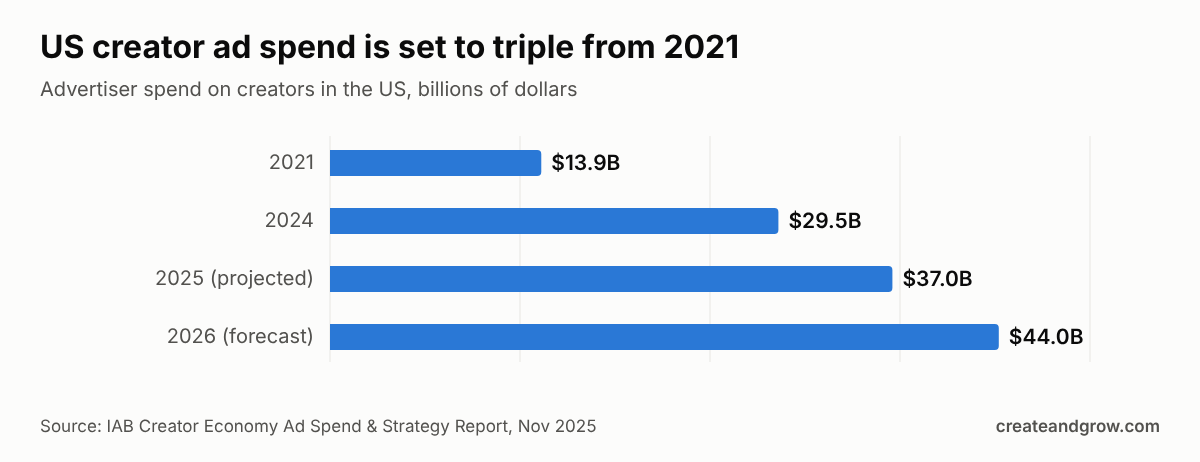
- US creator ad spend more than doubled from $13.9 billion in 2021 to $29.5 billion in 2024. (Source: IAB)
- Three in four brands use or plan to use AI for creator marketing tasks. (Source: IAB)
- Finding the right creators to partner with is the top challenge brands name in creator marketing. (Source: IAB)
- The global influencer marketing industry reached an estimated $32.55 billion in 2025, nearly double the 2022 estimate of $16.4 billion. (Source: Influencer Marketing Hub)
- Average annual influencer marketing budgets rose 171% year over year, and 71% of organizations increased their investment. (Source: CreatorIQ via Influencer Marketing Hub)
- Nearly two-thirds of that extra creator money came out of paid media budgets. (Source: CreatorIQ via Influencer Marketing Hub)
Influencer Budget and Program Statistics
Influencer Marketing Hub’s 2026 Benchmark Report, published in May 2026, is based on a survey of more than 600 marketers and agencies.
| Creator tier | Plan to expand | Plan to cut back |
|---|---|---|
| Nano | 51.43% | 10.00% |
| Micro | 52.83% | 7.55% |
| UGC creators | 50.00% | 0% |
| Macro | 20.59% | 20.58% |
- 72.22% of marketers expect to raise influencer budgets by 50% or more in 2026. (Source: Influencer Marketing Hub)
- 65.9% expect influencer campaigns to pay back within a month, including 48.4% within two weeks. (Source: Influencer Marketing Hub)
- 10.71% of brands use a hybrid in-house and agency model, and another 10.71% rely fully on an agency. (Source: Influencer Marketing Hub)
- Creator discovery and vetting is the task brands most often outsource (19.44%); reporting and analytics is the least outsourced (6.9%). (Source: Influencer Marketing Hub)
- About 80% of reported UGC creator rates were under $500 per piece. (Source: Influencer Marketing Hub)
- 77% of brands repurpose creator content in paid ads, and 67% include usage rights in the creator’s first contract. (Source: Aspire via Influencer Marketing Hub)
Influencer Marketing ROI and Measurement Statistics
- Brand awareness is the most selected influencer KPI; among brands raising budgets by 50% or more, 89% track it. (Source: Influencer Marketing Hub)
- Promo or discount codes are the most used tracking method (45.9%), ahead of affiliate links (26.0%) and native shop features (25.0%). (Source: Influencer Marketing Hub)
- Measuring ROI (8.70%) and attribution (7.14%) together make up 15.84% of the challenges marketers report. (Source: Influencer Marketing Hub)
- 79% of enterprise marketers struggle to measure influencer ROI, and 48% name attribution as their biggest gap. (Source: Linqia via Influencer Marketing Hub)
- 81% of enterprise marketers say creator content outperforms brand-made content. (Source: Linqia via Influencer Marketing Hub)
- Creators produced 33 times more posts about Fortune 100 brands than the brands’ own accounts, with 11 times the impressions. (Source: CreatorIQ via Influencer Marketing Hub)
Influencer Marketing Platform Statistics
- TikTok is the platform most often included in brands’ 2026 influencer plans, selected by 31% of respondents. (Source: Influencer Marketing Hub)
- 85% of brands use Instagram for creator marketing, and 29% say it gives their best return, against 27% for TikTok. (Source: CreatorIQ via Influencer Marketing Hub)
- 83% of brands rank long-form video among their three most effective influencer formats, and 80% say the same of short-form video. (Source: Influencer Marketing Hub)
- Only 14% rank Stories among their top three formats. (Source: Influencer Marketing Hub)
- 32% of brands already sell through TikTok Shop, and another 25% plan to start. (Source: Aspire via Influencer Marketing Hub)
- Creators post most of their branded content on TikTok (52%), but rank Instagram first for long-term potential (38%, against 35% for TikTok). (Source: CreatorIQ)
- Among creators earning more than $250,000 a year, 60% use Instagram as their main platform for branded content, against 30% for TikTok. (Source: CreatorIQ)
Creator Economy and Creator Pay Statistics
CreatorIQ’s State of Creators 2026, released in August 2026, surveyed 5,095 creators across 100 regions.
- For 62% of creators, content creation is not their main source of income. (Source: CreatorIQ)
- Just under 5% of creators earned more than $100,000 from content creation in the past year. (Source: CreatorIQ)
- 50% of creators have launched or plan to launch their own brand. (Source: CreatorIQ)
- 42% of creators feel tension between what their audience wants and what brands ask for, rising to 53% among those with 500,000+ Instagram followers. (Source: CreatorIQ)
- Across 14,400 creators paid through CreatorIQ campaigns in 2025, average earnings were $11,400 but the median was $3,000. (Source: CreatorIQ via Influencer Marketing Hub)
- The top 10% of creators received 62% of all creator payments, and the top 1% received 21%. (Source: CreatorIQ via Influencer Marketing Hub)
AI in Influencer Marketing
- Creator discovery is the most common use of AI in influencer marketing (36.67%), followed by content generation (21.11%) and brief writing (13.89%). (Source: Influencer Marketing Hub)
- Only 7.22% use AI for fraud detection, and 10.56% do not use AI at all. (Source: Influencer Marketing Hub)
- AI-driven creator matching is marketers’ top focus area for 2026 (26.89%), ahead of social commerce (19.33%). (Source: Influencer Marketing Hub)
- 72% of creators have used AI tools, mostly for brainstorming, writing or editing, but only 4% use it for strategy. (Source: CreatorIQ)
- 89% of enterprise marketers avoid virtual influencers. (Source: Linqia via Influencer Marketing Hub)
Consumer Trust in Influencers
BBB National Programs surveyed more than 3,700 US consumers for its Influencer Trust Index 2025.
| What consumers say | Share |
|---|---|
| Bought because of an influencer | 58% |
| Trust influencer content at least somewhat | 74% |
| Trust general advertising at least somewhat | 87% |
| Trust influencer content completely | 5% |
| Feel deceived by undisclosed partnerships | 70% |
- 79% say authentic reviews, even negative ones, raise their trust in an influencer. (Source: BBB National Programs)
- 71% say transparency about brand relationships raises their trust. (Source: BBB National Programs)
- 80% name influencers who are not genuine or transparent as a trust killer, ahead of unrealistic lifestyles (71%) and undisclosed brand deals (64%). (Source: BBB National Programs)
- 72% believe both brands and influencers should be held accountable for ad transparency. (Source: BBB National Programs)
Where the data disagrees
Market size depends on what is counted. Influencer Marketing Hub puts the global influencer marketing industry at $32.55 billion for 2025 (Source: Influencer Marketing Hub), while IAB projects $37 billion for US creator ad spend alone (Source: IAB). One measures US advertiser spend on creators, the other the global influencer marketing industry, so the definitions differ and the numbers should not be compared directly.
Platform rankings also depend on who you ask. Marketers pick TikTok most often for new investment (Source: Influencer Marketing Hub), but more brands already use Instagram and rate its ROI slightly higher (Source: CreatorIQ via Influencer Marketing Hub).
What These Influencer Statistics Mean for Brands
- Vet audiences, not follower counts. Bot followers are the biggest source of fraud.
- Go smaller and wider. Nano, micro and UGC creators are where brands plan to grow.
- Disclose every partnership. Hidden deals destroy trust faster than the ad itself.
- Agree what payback means. Most teams expect results within a month but still struggle with attribution.
- Budget for usage rights. Creator content now works as paid ad creative too.
Creators also shape what AI tools say about your brand. See how to influence LLM mentions and why brand mentions matter for AI search. If you run sponsorships, our guide to sponsorship marketing covers the basics, and our RedNote statistics show where some creators are moving.
Influencer Marketing Statistics FAQ
How big is the influencer marketing industry in 2026?
IAB forecasts US creator ad spend of $44 billion in 2026, up from a projected $37 billion in 2025. Globally, Influencer Marketing Hub estimated the influencer marketing industry at $32.55 billion in 2025. The figures differ because they measure different things.
Are influencer marketing budgets increasing?
Yes. In Influencer Marketing Hub’s 2026 survey of 600+ marketers, 87.49% expected budgets to increase and 72.22% expected rises of 50% or more. CreatorIQ found average annual influencer budgets rose 171% year over year, with most new money moved from paid media.
Which platform is best for influencer marketing?
It depends on the goal. TikTok is the top choice for new 2026 investment, selected by 31% of marketers. Instagram is used by 85% of brands and edges TikTok on perceived ROI, 29% to 27%. Video, long and short, ranks as the most effective format.
Do consumers trust influencers?
Only partly. BBB National Programs found 58% of US consumers have bought because of an influencer, but just 5% trust influencer content completely, against 87% who trust general advertising at least somewhat. Undisclosed partnerships make 70% feel deceived.
Related Reading