Digital PR has become harder and more valuable at the same time. 75% of digital PR practitioners say the work is more challenging in 2026 than a year earlier, yet 83.1% say it matters more because of AI search, according to BuzzStream’s 2026 State of Digital PR survey.
The reason is simple: AI assistants cite other people’s websites far more than a brand’s own. Below are the digital PR statistics for 2026 on journalists, pitching, link costs, results and AI visibility, each linked to its original source.
- Top Digital PR Statistics for 2026
- Journalist and Media Relations Statistics
- Digital PR Industry Statistics
- Digital PR and AI Visibility
- Where the Data Disagrees
- Digital PR Statistics FAQ
- Related Reading
Top Digital PR Statistics for 2026
- 75% of digital PRs say digital PR is more challenging in 2026 than in 2025. (Source: BuzzStream)
- 83.1% say digital PR is more important in 2026 because of AI. (Source: BuzzStream)
- 80% of AI citations in a study of 12,000 AI answers pointed to third-party websites, not the brand’s own site. (Source: BuzzStream)
- 66% of journalists rely on PR content such as press releases and pitches for story ideas, making PR their leading source of leads. (Source: Cision, 2026)
- 86% of journalists say at least some of their stories start with a PR pitch. (Source: Muck Rack, 2026)
- 72% of journalists say fewer than a quarter of the pitches they get are relevant. (Source: Cision)
- The most common known cost per link from digital PR is $300 to $500, and the share paying $750 or more rose from 3% to 10.2%. (Source: BuzzStream)
- 95.9% of digital PRs pitch data-led content, the most common tactic. (Source: BuzzStream)
- 85.2% of digital PRs see measurable results within six months. (Source: BuzzStream)
- 53% of journalists oppose receiving AI-generated pitches, while 21% are in favour. (Source: Cision)
Journalist and Media Relations Statistics
Cision surveyed 1,899 journalists in 19 markets in early 2026, and Muck Rack surveyed nearly 1,100. Their findings line up closely.
- Most journalists receive 50 or more PR pitches a week. (Source: Cision)
- 86% of journalists will reject a pitch that is not relevant to their audience or beat, and 79% are more likely to engage with one that is. (Source: Cision)
- 84% say the best way to start a relationship is a simple introductory email, even without a story to pitch. (Source: Cision)
- 53% of journalists rate their relationships with PR professionals as important or very important to their success. (Source: Muck Rack)
- Only 3% of journalists have their stories fully assigned; 55% work from a mix of pitches and assignments. (Source: Muck Rack)
- Accuracy and fighting misinformation is journalists’ top challenge (50%), followed by shrinking budgets and staff cuts (49%). (Source: Cision)
- 88% of journalists immediately disregard pitches that do not match their coverage area, and 54% seldom or never respond to a PR pitch. (Source: BuzzStream, citing Muck Rack)
- Digital-only outlets are now the most common workplace for journalists (25%). (Source: BuzzStream, citing Muck Rack)
What journalists want from PR
| What journalists want in a pitch | Share of journalists | Source |
|---|---|---|
| Data or original research | 47% | Cision |
| Embargoed or early-access information | 45% | Cision |
| Access to experts | 42% | BuzzStream, citing Cision |
Where journalists spend time
- 97% of journalists use social media for work, and LinkedIn is now the most used platform (62%), ahead of Instagram (54%) and Facebook (53%). (Source: Cision)
- 33% rank LinkedIn as the single most valuable platform for their work. (Source: Cision)
- Only 21% of journalists say social media is very important to producing their work, down from 33% in 2024. (Source: Muck Rack)
- 82% of journalists now use AI, with ChatGPT at 47% and Gemini at 22%. (Source: Muck Rack)
- 48% of journalists use AI for brainstorming and 43% for research or fact-checking. (Source: Cision)
Digital PR Industry Statistics
Tactics and challenges
- Getting coverage is the biggest challenge (26.4%), followed by measuring impact (14.9%) and keeping up with industry changes (14.2%). (Source: BuzzStream)
- 60.8% say finding relevant journalists is harder in 2026 than in 2025. (Source: BuzzStream)
- Pitching press releases has climbed to 79.1% of digital PRs. (Source: BuzzStream)
- 53.4% of digital PRs work most closely with SEO teams, while only 10.1% work most closely with PR teams, down from 14.5%. (Source: BuzzStream)
- 28.4% say digital PR was easier to sell this year, up from 15%. (Source: BuzzStream)
- Only about half of digital PRs personalise their pitches every time. (Source: BuzzStream)
- 55.4% send just one follow-up email to journalists. (Source: BuzzStream)
Budgets and cost per link
| Metric | 2026 figure | Source |
|---|---|---|
| Budgets under $10,000 a month | About 60% | BuzzStream |
| Budgets under $5,000 a month | 25.7% | BuzzStream |
| Budgets over $20,000 a month | 8.8% (up from 4%) | BuzzStream |
| Most common known cost per link | $300 to $500 (19.6%) | BuzzStream |
| Cost per link of $750 or more | 10.2% (up from 3%) | BuzzStream |
| Do not know their cost per link | About 40% | BuzzStream |
For a fuller picture of link prices across tactics, see our link building pricing guide and link building statistics, or estimate a campaign with our digital PR budget calculator.
Results and KPIs
- Number of quality links is the top success metric (85.1%), ahead of total mentions (72.3%) and total links (70.9%). (Source: BuzzStream)
- 93.2% of digital PRs use Ahrefs Domain Rating to judge authority, up from 83.3%. (Source: BuzzStream)
- 51.4% see results in three to six months, and 33.8% in one to three months. (Source: BuzzStream)
- 68.2% believe digital PR is more effective than it was a year ago. (Source: BuzzStream)
- 32.5% say one team member can earn 31 or more links a month, roughly one per working day. (Source: BuzzStream)
- About 80% never pay for link placements, and more than 90% believe client goals can be hit without buying links. (Source: BuzzStream)
- Finance is the hardest industry to earn links in (23.6%), and travel the easiest (46.6%). (Source: BuzzStream)
Digital PR and AI Visibility
BuzzStream tracked 12,000 AI responses across Google AI Mode, AI Overviews, Gemini and GPT-5.4-mini, covering about 200 brands. The results show why earned coverage matters for AI search.
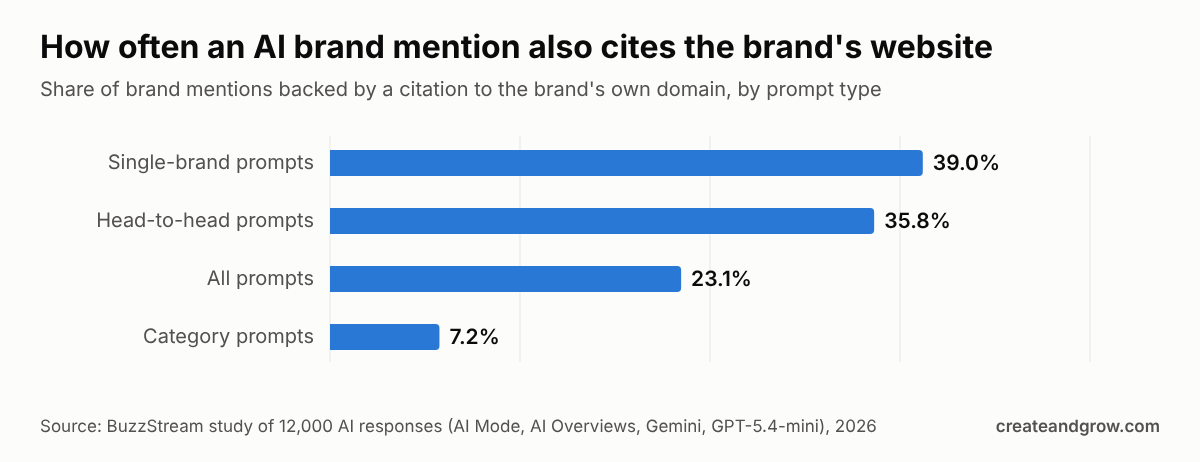
- Only 23.1% of brand mentions in AI answers come with a citation to the brand’s own site. (Source: BuzzStream)
- When a brand’s site is cited, the answer names the brand 69.9% of the time. (Source: BuzzStream)
- On open “best X” category prompts, just 7.2% of brand mentions are backed by a citation to the brand. (Source: BuzzStream)
- Google AI Mode cites about 33 URLs per answer, while GPT-5.4-mini cites 3.8 but names 92.7% of the brands it cites. (Source: BuzzStream)
- Healthcare brands are most likely to have mentions backed by citations (34.5%); retail brands the least (16.5%). (Source: BuzzStream)
- Only about 40% of digital PRs have a repeatable way to get clients cited in AI answers. (Source: BuzzStream)
- 73.6% of digital PRs use AI mainly for ideation, and 41.2% use it in pitch writing. (Source: BuzzStream)
In short, most of what AI says about your brand is shaped by other sites. That is why we treat brand mentions and digital PR as core parts of AI visibility. Our guide on how to influence LLM mentions explains the approach, and our Perplexity and Claude statistics show which assistants send traffic.
Where the Data Disagrees
Pitch-volume figures are quoted inconsistently. BuzzStream’s roundup attributes “72% receive more than 50 pitches a week” to Cision, while Cision’s own 2026 release uses 72% for the share of journalists who say fewer than a quarter of pitches are relevant, and says only that “most” journalists get 50 or more a week. We use Cision’s own wording. Most figures here are self-reported surveys, and cost-per-link data comes only from the roughly 60% who track it.
Digital PR Statistics FAQ
Is digital PR worth it in 2026?
Most practitioners think so. 68.2% say digital PR is more effective than a year ago and 85.2% see results within six months. It also matters for AI search: 80% of AI citations point to third-party sites, which is exactly where digital PR earns coverage.
How much does a digital PR link cost?
The most common known cost per link in 2026 is $300 to $500, reported by 19.6% of practitioners, and 10.2% now pay $750 or more. About 40% do not track the figure, so treat these numbers as a floor for competitive placements.
How many pitches do journalists get?
Cision’s 2026 survey of 1,899 journalists says most receive 50 or more pitches a week, and 72% say fewer than a quarter are relevant. Relevance is the deciding factor: 86% reject pitches that do not fit their audience or beat.
Do journalists accept AI-written pitches?
Mostly not. 53% of journalists oppose AI-generated pitches and press releases, while 21% are in favour. Many journalists use AI themselves for brainstorming and research, but they expect outreach to be relevant and written by a person.
Related Reading