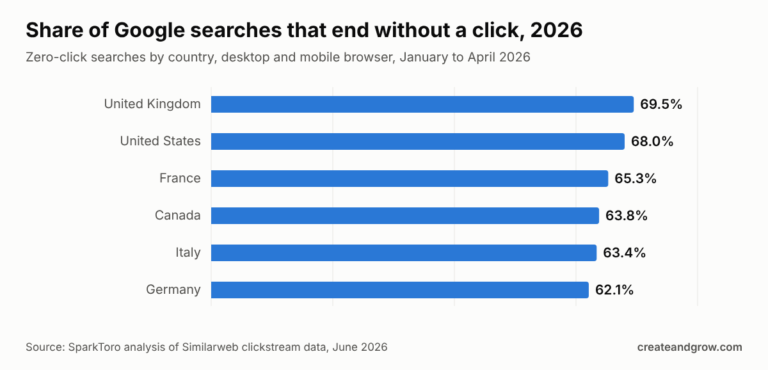
AI search is no longer a side feature. Google says AI Overviews now reach more than 2.5 billion people a month and AI Mode passed 1 billion monthly users within a year of launch. At the same time, the top organic result loses more than half of its clicks when an AI Overview appears above it.
Below are the most useful AI search statistics for 2026, grouped by topic, with the date and source of every number. Where studies disagree, we show both figures and explain why they differ.
- Top AI Search Statistics for 2026
- How Many People Use Google AI Overviews and AI Mode?
- How Often Do AI Overviews Appear?
- AI Overviews and Click-Through Rates
- Why Being Cited in AI Overviews Matters
- AI Search Referral Traffic Statistics
- How AI Search Is Changing Search Behavior
- Why AI Search Statistics Often Disagree
- What These AI Search Statistics Mean for Marketers
- AI Search Statistics FAQ
- Related Reading
Top AI Search Statistics for 2026
- Google AI Overviews have more than 2.5 billion monthly users. (Source: Google, I/O 2026 keynote)
- Google AI Mode passed 1 billion monthly users about a year after its US launch. (Source: Google, I/O 2026 keynote)
- When an AI Overview appears, the click-through rate of the #1 organic result is 58% lower on average. (Source: Ahrefs, February 2026)
- Google users clicked a traditional result on 8% of searches with an AI summary, compared with 15% of searches without one. (Source: Pew Research Center)
- Brands cited inside an AI Overview get 120% more organic clicks per impression than brands that are not cited on the same results page. (Source: Seer Interactive, April 2026)
- AI Overviews appeared on 86.7% of business and buying-intent prompts in April 2026, up from 56.9% a year earlier. (Source: Peec AI)
- Comparison queries (“X vs Y”) trigger an AI Overview 95.4% of the time. (Source: Seer Interactive)
- AI platforms sent 0.32% of all website traffic in 2026, a 16x increase since 2024. (Source: SE Ranking, June 2026)
- ChatGPT sends 74.78% of all AI referral traffic, followed by Gemini (11.56%) and Perplexity (7.23%). (Source: SE Ranking)
- Only about one-third of US consumers believe GenAI chatbots are as effective as search engines for learning new information. (Source: Gartner, January 2026)
How Many People Use Google AI Overviews and AI Mode?
Google does not publish a share of searches with AI Overviews, but it does publish user counts. The growth in a single year is the headline.
- 2.5 billion+ monthly users of AI Overviews, announced by Sundar Pichai at Google I/O on May 19, 2026. (Source: Google)
- 1 billion+ monthly users of AI Mode within one year, with AI Mode queries more than doubling every quarter since launch. (Source: Keywords Everywhere I/O 2026 recap of Google’s announcements)
- The Gemini app grew from 400 million monthly users at I/O 2025 to more than 900 million at I/O 2026. (Source: Google)
- Google processed more than 3.2 quadrillion tokens a month across its products by May 2026, up from about 480 trillion a year earlier and 9.7 trillion two years earlier. (Source: Google)
- At I/O 2026, Google merged AI Overviews and AI Mode into one experience and made Gemini 3.5 Flash the default model. (Source: Keywords Everywhere)
- 82% of US consumers say they have noticed AI Overviews in search results. (Source: Gartner)
- 58% of US adults in Pew’s panel ran at least one Google search that produced an AI summary in March 2025. (Source: Pew Research Center)
For context, Gartner predicted back in February 2024 that traditional search engine volume would drop 25% by 2026 as chatbots took over queries. (Source: Gartner) Google’s own position in 2026 is the opposite: Pichai says people who use AI features in Search tend to search more. Neither claim has been confirmed by independent data on total query volume.
How Often Do AI Overviews Appear?
This is where the numbers vary most, because every study uses a different set of keywords. A dataset of buying-intent prompts will show far more AI Overviews than a random sample of all Google searches.
| Study | Data period | Share of searches with an AI Overview |
|---|---|---|
| Pew Research Center | March 2025, 68,879 real US searches | 18% |
| Seer Interactive | Feb 2026, 49,353 queries from 53 brands | 36% of informational, 8% of commercial, 5% of transactional |
| Peec AI | April 2026, 500,000 business prompts | 86.7% |
- Longer searches trigger more AI summaries: 8% of one- or two-word searches vs. 53% of searches with 10 or more words. (Source: Pew Research Center)
- 60% of searches that start with “who”, “what”, “when” or “why” produce an AI summary. (Source: Pew Research Center)
- Seer found AI Overviews on 95.4% of comparison queries, 86.3% of review queries, 85.9% of question queries, 83.4% of price queries and 81.3% of “best” queries. (Source: Seer Interactive)
- Even 76.9% of informational “near me” searches showed an AI Overview, and single-word informational queries showed one 27.3% of the time. (Source: Seer Interactive)
- AI Overviews appeared on 76% of prompts inside the EU vs. 90.3% outside it, and on 0% in France. (Source: Peec AI)
- The median AI summary was 67 words long, and 88% cited three or more sources. (Source: Pew Research Center)
- About 9% of AI Overviews appear below the first organic position rather than at the top. (Source: Ahrefs)
AI Overviews and Click-Through Rates
Almost every independent study finds that AI Overviews reduce organic clicks. The size of the drop is what differs.
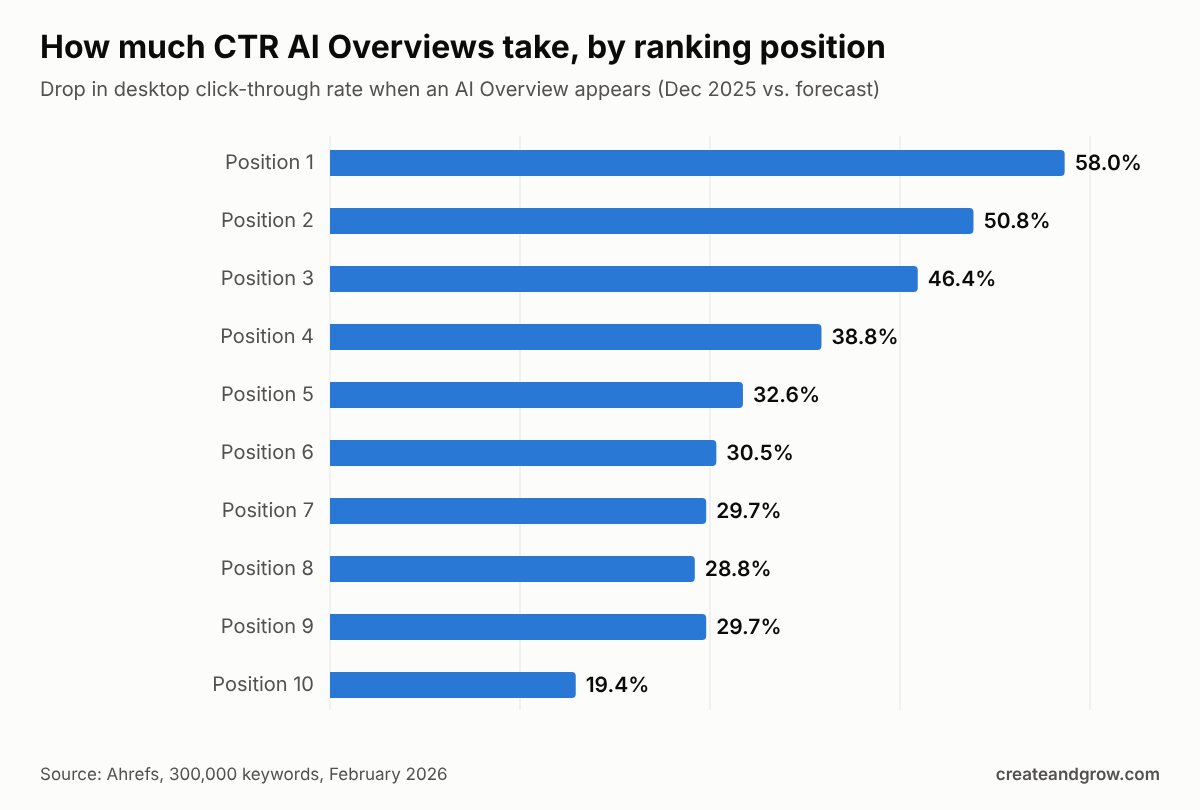
- The #1 result’s average desktop CTR on AI Overview keywords fell from 7.3% in December 2023 to 1.6% in December 2025. (Source: Ahrefs)
- Ahrefs’ estimate of the CTR loss for position one rose from 34.5% (April 2025 study) to 58% (February 2026 study). (Source: Ahrefs)
- Users ended their browsing session on 26% of Google pages with an AI summary, compared with 16% of pages without one. (Source: Pew Research Center)
- Only 1% of visits to a results page with an AI summary ended in a click on a link inside the summary. (Source: Pew Research Center)
- Organic CTR on queries with an AI Overview hit a low of 1.31% in December 2025, then rebounded to 2.36% in February 2026. (Source: Seer Interactive)
- Organic CTR on queries without an AI Overview rose from 2.75% in January 2025 to 3.82% in February 2026. (Source: Seer Interactive)
- Paid CTR stayed far steadier: 14.64% in January 2025 and 16.21% in February 2026 on queries with an AI Overview. (Source: Seer Interactive)
- 31% of consumers say AI summaries make them spend more time searching, vs. 16% who spend less, and over two-thirds keep scrolling past the AI Overview. (Source: Gartner)
The practical takeaway: informational content still gets read, but more of that reading happens on Google. If your traffic comes mainly from “what is” and “how to” queries, plan for fewer clicks per ranking. Our guide to a zero-click SEO strategy covers what to do about it.
Why Being Cited in AI Overviews Matters
The biggest difference in clicks is not whether an AI Overview appears, but whether your site is one of its sources.
| Situation (informational queries) | Organic clicks per 1 million impressions |
|---|---|
| No AI Overview on the page | ~33,500 |
| AI Overview, your brand is cited | ~20,743 |
| AI Overview, your brand is not cited | ~9,445 |
- Being cited delivers 120% more organic clicks per impression than not being cited, but still 38% fewer than a page with no AI Overview at all. (Source: Seer Interactive)
- Organic CTR for brands that were on an AI Overview page but not cited fell 67% over 2025. (Source: Seer Interactive)
- Wikipedia, YouTube and Reddit made up 15% of all sources linked in Google’s AI summaries. (Source: Pew Research Center)
- Government (.gov) sites made up 6% of AI summary sources but only 2% of standard results. (Source: Pew Research Center)
Getting cited is a mix of clear, quotable content and third-party authority. We explain the process in AI search visibility, and you can track where you appear with these tools for tracking AI Overview mentions.
AI Search Referral Traffic Statistics
AI assistants send real visits now, but the volume is still small next to Google. These numbers come from SE Ranking’s analysis of 101,574 websites from January 2025 to April 2026.
- AI platforms sent 0.32% of all website traffic in 2026, up from 0.24% in 2025 and 0.02% in 2024. That is roughly 1 in every 312 visits. (Source: SE Ranking)
- Organic search still drives 42.75% of all website traffic, about 134 times more than AI platforms. At the start of 2025 the gap was about 300x. (Source: SE Ranking)
- ChatGPT’s share of AI referrals fell from 79.74% in 2025 to 74.78% in 2026, even though its referral traffic grew 27%. (Source: SE Ranking)
- Gemini referrals grew 231% and Claude referrals grew 320% year over year. Perplexity was the only major AI engine whose referrals declined. (Source: SE Ranking)
- AI search sent 0.29% of website traffic in the US, 0.27% in the EU and 0.16% in the UK in 2026. (Source: SE Ranking)
- Visitors from AI platforms spent 67.7% more time on site than organic visitors (9 min 19 s vs. 5 min 33 s, early-2025 data). (Source: SE Ranking)
For a closer look at individual assistants, see our ChatGPT statistics and Perplexity and Claude statistics.
How AI Search Is Changing Search Behavior
- 51% of US consumers say their research habits have changed because of GenAI. Of those, 71% changed how they phrase queries. (Source: Gartner)
- 38% of those consumers now use more specific search terms, 26% ask questions and 26% use conversational phrasing. (Source: Gartner)
- 18% use GenAI tools to write prompts before they search on Google. (Source: Gartner)
- 31% of consumers consider more product options because of AI Overviews, compared with 7% who consider fewer. (Source: Gartner)
- 36% of Google searches that contain both a noun and a verb (full sentences) produce an AI summary. (Source: Pew Research Center)
Longer, conversational queries also tie into older trends like voice search. For the wider SEO picture, see our SEO statistics.
Why AI Search Statistics Often Disagree
- Different keyword sets. Pew used real searches from 900 people; Peec used 500,000 business prompts. That alone explains most of the gap between 18% and 86.7%.
- Different years. AI Overviews expanded fast. A 2025 study and a 2026 study measure different products.
- Correlation, not proof. Ahrefs and Seer both state their CTR findings show correlation. Higher-authority brands are also more likely to be cited.
- Google’s own numbers count users, not clicks. “2.5 billion users” means people who saw an AI Overview at least once in a month, not how many searches show one.
What These AI Search Statistics Mean for Marketers
- Track citations, not just rankings. A cited page earns roughly twice the clicks of an uncited one on the same results page.
- Expect fewer clicks on question and comparison content, and measure impressions and clicks separately before deciding a page has failed.
- Build mentions on the sites AI tools trust. Digital PR and brand mentions feed the sources AI answers pull from (see our digital PR statistics).
- Check that AI crawlers can reach your site with our free robots.txt AI bot checker.
If you want help getting your brand into AI answers, our AI search visibility service starts with an audit of where you show up today.
AI Search Statistics FAQ
What percentage of Google searches show an AI Overview?
It depends on the query mix. Pew found AI summaries on 18% of real US searches in March 2025. Seer found them on 36% of informational queries in 2026, and Peec found them on 86.7% of business and buying-intent prompts in April 2026.
Do AI Overviews reduce website traffic?
Yes, for most informational queries. Ahrefs found the top result’s CTR is 58% lower when an AI Overview appears, and Pew found users clicked traditional results about half as often. Pages cited inside the AI Overview lose much less traffic than pages that are not cited.
How many people use Google AI Mode?
Google said at I/O in May 2026 that AI Mode passed 1 billion monthly users, about one year after it launched in the US. AI Overviews, which appear directly on the results page, have more than 2.5 billion monthly users.
Which AI search engine sends the most traffic to websites?
ChatGPT. SE Ranking found it sends 74.78% of all AI referral traffic in 2026. Gemini is second with 11.56% and has overtaken Perplexity, which is third with 7.23%. Copilot and Claude follow.
Related Reading