

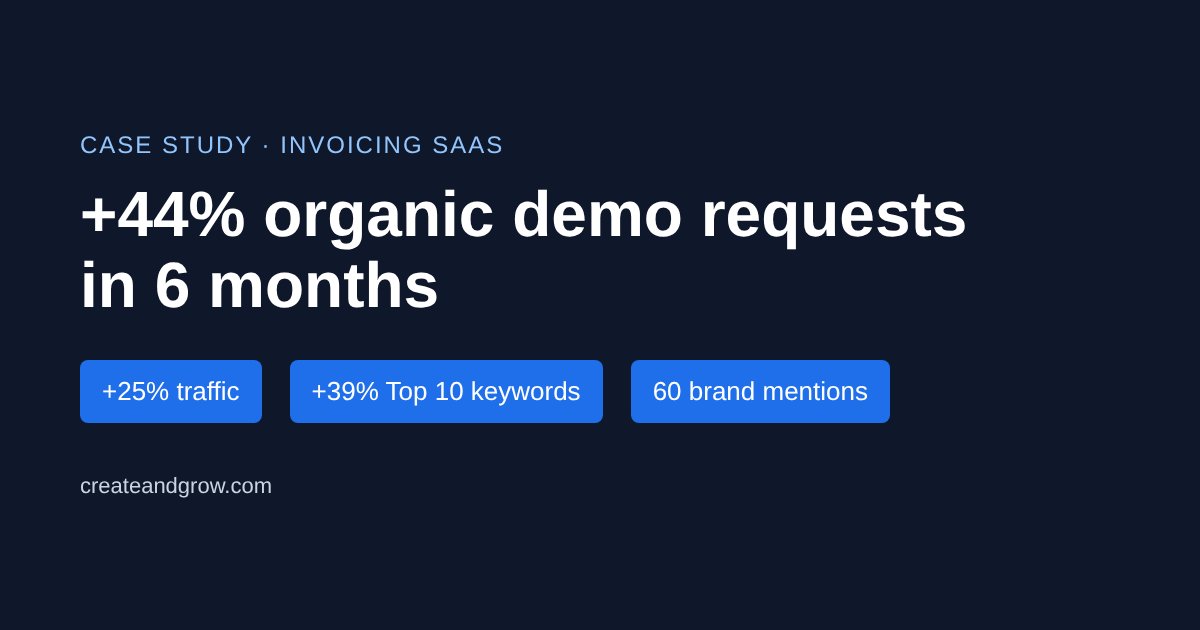
Here is how we helped an invoicing software company grow organic demo requests by 44% in 6 months, with 60 brand mentions, links and listicles on relevant websites and a clear message about which problems the product solves.
*This client asked us not to reveal their name or publish screenshots from their tools. Every chart below was recreated by us from their data.*
The results in 6 months
- +25% organic traffic
- +31% ranking keywords
- +39% keywords in Google’s Top 10
- +44% organic demo requests
- 60 brand mentions, links and listicles (10 per month) on quality, relevant websites
- 61 average Domain Rating (DR) of the linking websites
- The brand started appearing in AI answers for several of the problems we targeted (tracked in Profound)
Data: the client’s own analytics. Chart recreated by Create & Grow because the client asked us not to publish their screenshots.
Traffic grew less than demo requests, and that was the goal. We didn’t chase broad, low-intent traffic. We went after people who already had the problem the software solves.
Where the client started
The product was good, but the web described it the same way it described every competitor: as an “invoicing management platform”. Competitors were already in the listicles people and AI tools read. And the client had no case studies at all, so there was nothing concrete to point to.
Step 1: We listened to how customers talk
Keyword research still matters, and we did it. But we went one step further and collected the exact words the client’s own customers use. Our sources:
- Support tickets: what customers complain about and ask for help with
- Sales call transcripts: how prospects describe their problem before they buy
- Live chat conversations: quick, unfiltered questions from visitors
- Reviews: what customers praise and what pushed them to switch
- Internal site search data: what visitors type into the search box on the client’s website
Customers rarely used industry terms like “accounts receivable automation”. They described everyday frustrations instead. That gave us something better than a keyword list: the exact problems people wanted to solve.
| What customers said | How we described the brand in every placement |
|---|---|
| “I spend too much time chasing late payments” | [Brand] helps small businesses reduce late payments by automating invoice reminders. |
| “I keep making mistakes on invoices” | [Brand] cuts invoice errors with templates and automatic calculations. |
| “I waste hours creating the same invoices every month” | [Brand] sends recurring invoices automatically, so you set them up once. |
| “I never know how much money I’ll actually have next month” | [Brand] shows what is due and when, so cash flow is easier to predict. |
Example wording. [Brand] stands for the client’s name, which the real placements used as the anchor text.
I wrote about this approach in more detail in my article for Entrepreneur, in the section “Speak Your Customers’ Language Everywhere Your Brand Appears”. This case study shows what it looked like in practice.
Step 2: We connected the brand to those problems everywhere
We never described the client as just another “invoicing platform”. We connected the brand to the problems of its customers and presented it as the solution to those problems.
Every placement followed the same rule, whether it was a digital PR piece, a guest post or a niche edit:
- The paragraph always mentions the client’s brand by name
- It names a real customer problem from Step 1, in the customers’ own words (for example, chasing late payments)
- It explains how the brand solves that problem and for whom
- The brand name is the anchor text, linking to the client’s website
- Where it fits, it adds a real result from the client’s case studies
Fact-based listicles with the client at #1
We published listicles that ranked the client first and compared it with other invoicing software. Every comparison was based on facts: concrete, measurable numbers that anyone can find and check online. We found where the client is genuinely better than its competitors and showed it. The client’s link in these listicles was dofollow.
Comparison posts against top competitors
We also wrote head-to-head comparison posts against the client’s main competitors, again using only public, verifiable facts.
Guest posts and niche edits
We placed the brand in guest posts and in relevant existing articles (niche edits), always inside a paragraph that explains the problem it solves. Read more about how we run brand mentions and link building.
Digital PR campaigns
We ran several digital PR campaigns that earned mentions on news websites. Some were dofollow, some nofollow, and some were brand mentions without a link. All of them help, because AI systems learn from what credible sites say about a brand, not only from links.
10 placements per month on relevant, quality websites, average DR 61. Chart by Create & Grow.
Step 3: We fixed what was missing on their own website
Public pricing
The client had no public prices. We added a pricing page. Today, if AI systems can’t find what a tool costs, they rarely recommend it, because people ask questions like “What’s the best affordable invoicing software for freelancers?” and the AI needs a price to answer.
Real case studies from their customers
When the client came to us, they had zero case studies. We started building them from their real customers: each case study names the customer’s company in the title, together with a real person from that company who recommends the product. Now every new placement could point to a real result instead of a vague claim.
What didn’t work: Reddit
We also tried Reddit. That campaign failed. Reddit has been removing accounts lately, including real, aged accounts, and many of the ones we used were deleted. We stopped it and focused on listicles, guest posts and niche edits, which kept working.
Why this works for AI search
Imagine someone asks ChatGPT: “What software can help me stop chasing clients for unpaid invoices?” If many credible websites describe the same brand as the solution to exactly that problem, AI systems have clearer information to work with. There is no guarantee, but in this project we tracked the brand in Profound and saw it start appearing in answers for several of the problems we targeted. You can read more in how ChatGPT chooses sources and on our AI SEO page.
The lesson
Don’t just optimize for the words your customers use. Make sure those words are consistently connected to your brand name and the problems it solves, on your site and everywhere else your brand appears.
Want the same for your SaaS? See our SaaS link building plans or talk to us.


