ChatGPT is still the biggest AI assistant in the world. OpenAI’s products passed 1 billion weekly active users in August 2026, and 44% of US adults now say they use ChatGPT. But its lead is shrinking: its share of generative AI web traffic fell from about 76% to 53% in a year as Gemini and Claude grew faster.
These are the ChatGPT statistics that matter in 2026: users, how people use it, revenue, traffic and what it means for brands that want to show up in its answers. Every number links to its source.
- Top ChatGPT Statistics for 2026
- How Many People Use ChatGPT?
- ChatGPT Usage in the US
- What Do People Use ChatGPT For?
- ChatGPT Traffic and Market Share
- ChatGPT Statistics for Marketers and SEOs
- OpenAI Revenue and Business Statistics
- How Americans Feel About AI Chatbots
- ChatGPT Statistics FAQ
- Related Reading
Top ChatGPT Statistics for 2026
- OpenAI’s products passed 1 billion weekly active users in August 2026, up from 900 million in February. (Source: AI Magazine)
- OpenAI reported in October 2026 that more than 1.2 billion people use ChatGPT every week. (Source: AI Magazine)
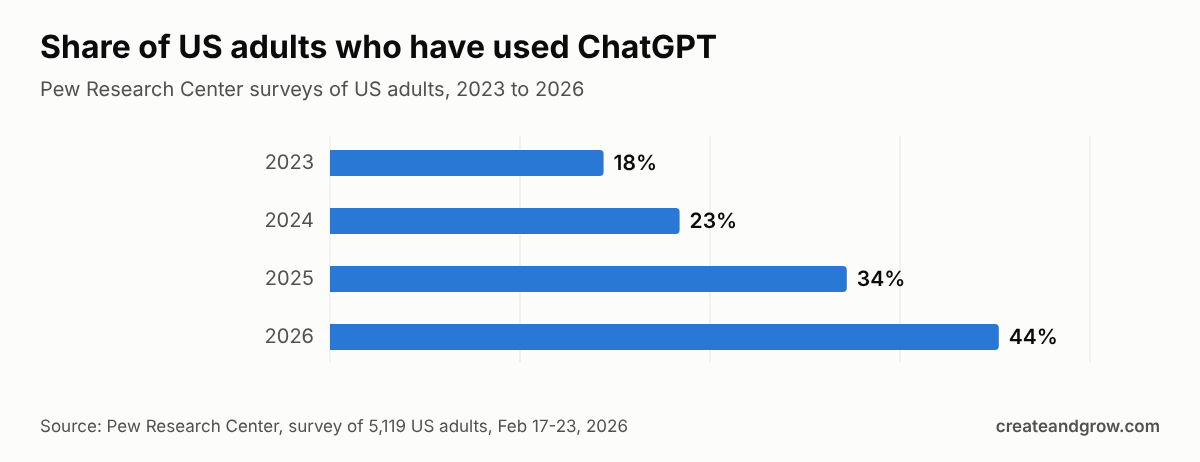
- 44% of US adults say they use ChatGPT, up from 18% in 2023. (Source: Pew Research Center, 2026)
- OpenAI had 50 million paying subscribers by February 2026. (Source: TechCrunch)
- ChatGPT’s share of generative AI website visits fell from about 76% in June 2025 to about 53% in May 2026. (Source: Similarweb)
- More than 70% of ChatGPT messages are not related to work. (Source: NBER working paper by OpenAI and Harvard researchers)
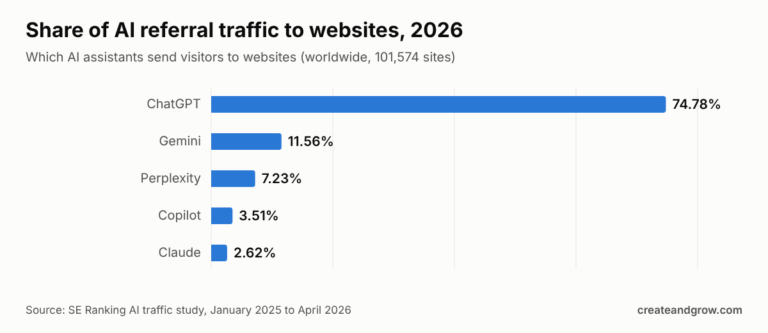
- ChatGPT sends 74.78% of all AI referral traffic to websites. (Source: SE Ranking, 2026)
- Roughly 26% of ChatGPT responses now contain an ad. (Source: Similarweb)
- OpenAI has more than two million business customers, and enterprise now brings in most of its revenue. (Source: AI Magazine, citing CFO Sarah Friar via CNBC)
- Citations appeared in 6.8% of US ChatGPT prompts in May 2026, up from 1.6% a year earlier. (Source: Similarweb)
How Many People Use ChatGPT?
| Date | ChatGPT weekly active users | Source |
|---|---|---|
| October 2025 | 800 million | TechCrunch |
| February 2026 | 900 million | TechCrunch |
| August 2026 | 1 billion (all OpenAI products) | AI Magazine |
| October 2026 | 1.2 billion+ | AI Magazine |
- About one in eight people online uses ChatGPT every week. (Source: AI Magazine)
- By July 2025, ChatGPT had been adopted by around 10% of the world’s adult population. (Source: NBER)
- Early ChatGPT users were mostly male, but the gender gap has narrowed sharply, and growth has been faster in lower-income countries. (Source: NBER)
- OpenAI said January and February 2026 were on track to be its biggest months ever for new subscribers. (Source: TechCrunch)
- Codex, OpenAI’s coding agent, had more than two million weekly users in March 2026. (Source: AI Magazine)
ChatGPT Usage in the US
Pew Research Center has asked US adults about ChatGPT every year since 2023. Its February 2026 survey of 5,119 adults shows steady growth.
- Adults under 50 are about twice as likely as those 50 and older to use ChatGPT (57% vs. 28%). (Source: Pew Research Center)
- 49% of US adults use at least one AI chatbot, up from 33% in 2024. (Source: Pew Research Center)
- 24% of US adults use a chatbot every day, including 12% who use one several times a day and 4% who use one almost constantly. (Source: Pew Research Center)
- ChatGPT (44%) is far ahead of Gemini (24%), Copilot (17%), Meta AI (14%), Grok (8%) and Claude (6%) among US adults. (Source: Pew Research Center)
What Do People Use ChatGPT For?
- Non-work messages grew from 53% to more than 70% of all ChatGPT usage. (Source: NBER)
- “Practical guidance”, “seeking information” and “writing” make up nearly 80% of all ChatGPT conversations. (Source: NBER)
- Writing is the most common work task, while computer programming and self-expression are relatively small shares of use. (Source: NBER)
- 42% of US adults use chatbots to search for information, and 38% of employed adults use them for work tasks. (Source: Pew Research Center)
- 25% use chatbots for fun, 24% to create or edit images or video, 20% for medical advice and 13% to get news. (Source: Pew Research Center)
- 10% of US adults use chatbots for emotional support and 4% for companionship. (Source: Pew Research Center)
- 30% of US adults say chatbots help their productivity, compared with 5% who say they hurt it. (Source: Pew Research Center)
- Similarweb found ChatGPT’s usage mix is the closest of the major assistants to a general search engine, while Claude and Gemini skew more toward programming. (Source: Similarweb)
Because so many people use ChatGPT to look things up, it now competes with Google for the top of the funnel. See our AI search statistics for how this is changing Google itself.
ChatGPT Traffic and Market Share
- Generative AI sites averaged 9.5 billion monthly web visits between June 2025 and May 2026, up 70% year over year. (Source: Similarweb)
- ChatGPT’s share of those visits fell from about 76% to about 53%, while Gemini rose from under 9% to around 27% to 28% and Claude from about 2% to close to 9%. (Source: Similarweb)
- ChatGPT’s absolute visits stayed roughly flat; the category simply grew faster around it. (Source: Similarweb)
- chatgpt.com still gets more web visits than Gemini, Claude and Perplexity combined. (Source: Similarweb)
- ChatGPT’s app has the highest “stickiness” (share of monthly users active daily) of the four big assistants. (Source: Similarweb)
- By year-over-year app growth, ChatGPT is the slowest of the four, behind Claude, Perplexity and Gemini. (Source: Similarweb)
For the challengers, read our Perplexity and Claude statistics. For an earlier rival, see our DeepSeek statistics.
ChatGPT Statistics for Marketers and SEOs
For brands, the question is not how many people use ChatGPT, but whether ChatGPT sends them visits and mentions them in answers.
- ChatGPT sent 74.78% of all AI referral traffic to websites in 2026, down from 79.74% in 2025. (Source: SE Ranking)
- ChatGPT’s referral traffic to websites still grew 27% year over year. (Source: SE Ranking)
- After ChatGPT started showing clickable brand names in May 2026, homepage referrals rose from about 26% to 29% of its referral traffic to about 62% to 63%. (Source: Similarweb)
- Citations appeared in 6.8% of US ChatGPT prompts in May 2026, up from 1.6% in June 2025. (Source: Similarweb)
- Citation rates vary by category: about 23% for travel and hospitality, about 20% for automotive and under 4% for professional services. (Source: Similarweb)
- About a third of ChatGPT ad impressions appear in the first response of a session, and about a fifth appear ten or more messages in. (Source: Similarweb)
In practice, this means a ChatGPT mention often sends people straight to your homepage or makes them search for your brand later. Our guide on how to get cited by ChatGPT and our brand mentions service cover how to earn those mentions.
OpenAI Revenue and Business Statistics
- OpenAI raised $110 billion in February 2026 at a $730 billion pre-money valuation, with $50 billion from Amazon and $30 billion each from Nvidia and SoftBank. (Source: TechCrunch)
- The round closed at $122 billion in March 2026, valuing OpenAI at $852 billion post-money. (Source: AI Magazine)
- OpenAI was earning about $2 billion a month by March 2026. (Source: AI Magazine)
- The Financial Times reported annualised revenue close to $50 billion at the end of September 2026. (Source: AI Magazine)
- OpenAI’s APIs process more than 15 billion tokens a minute. (Source: AI Magazine)
- OpenAI projects revenue growing from $36 billion in 2026 to $350 billion in 2030, according to the FT. (Source: AI Magazine)
Revenue figures for OpenAI come from investor documents and press reports, not audited accounts, and different outlets have published different numbers. Treat them as estimates.
How Americans Feel About AI Chatbots
- 63% of US adults think AI is advancing too quickly; only 2% say too slowly. (Source: Pew Research Center)
- 71% think AI will make their personal information less secure. (Source: Pew Research Center)
- 40% expect AI to have a negative impact on society over the next 20 years, vs. 16% who expect a positive one. (Source: Pew Research Center)
For broader numbers on chatbots and AI tools, see our chatbot statistics and generative AI statistics.
ChatGPT Statistics FAQ
How many people use ChatGPT in 2026?
OpenAI’s products passed 1 billion weekly active users in August 2026, and OpenAI reported in October that more than 1.2 billion people use ChatGPT each week. In February 2026 the figure was 900 million weekly users with 50 million paying subscribers.
What percentage of Americans use ChatGPT?
44% of US adults said they use ChatGPT in Pew Research Center’s February 2026 survey, up from 34% in 2025 and 18% in 2023. Adults under 50 are about twice as likely to use it as adults 50 and older (57% vs. 28%).
Is ChatGPT losing market share?
Yes, in share, not in absolute use. Similarweb data shows ChatGPT’s share of generative AI web visits fell from about 76% in June 2025 to about 53% in May 2026, while its total visits stayed roughly flat. Gemini and Claude took most of that share.
Does ChatGPT send traffic to websites?
Yes. ChatGPT sends about three-quarters of all AI referral traffic, and that traffic grew 27% in 2026. Still, AI platforms as a whole send only 0.32% of all website traffic, so Google remains far bigger as a traffic source.
Related Reading