

68% of Google searches in the US now end without a click to any website, according to SparkToro’s June 2026 analysis of Similarweb clickstream data. That is up from 60% in 2024, the fastest two-year rise SparkToro has recorded, and AI Overviews are the main reason.
The zero-click search statistics below show how big the shift is, how it differs by country, what AI Overviews do to click-through rates and what still earns clicks. Every figure links to its original source.
- Top Zero-Click Search Statistics for 2026
- How Many Searches End Without a Click?
- Zero-Click Searches by Country
- AI Overviews and Zero-Click Searches
- Zero-Click Beyond Google: AI Assistants
- What Zero-Click Search Means for Your SEO
- Zero-Click Search FAQ
- Related Reading
Top Zero-Click Search Statistics for 2026
- 68.01% of US Google searches ended without a click in January to April 2026. (Source: SparkToro and Similarweb)
- That is up from 60.45% in 2024, a rise of 7.5 percentage points in two years. (Source: SparkToro)
- About ten years ago, roughly 45% of Google searches were zero-click. (Source: SparkToro)
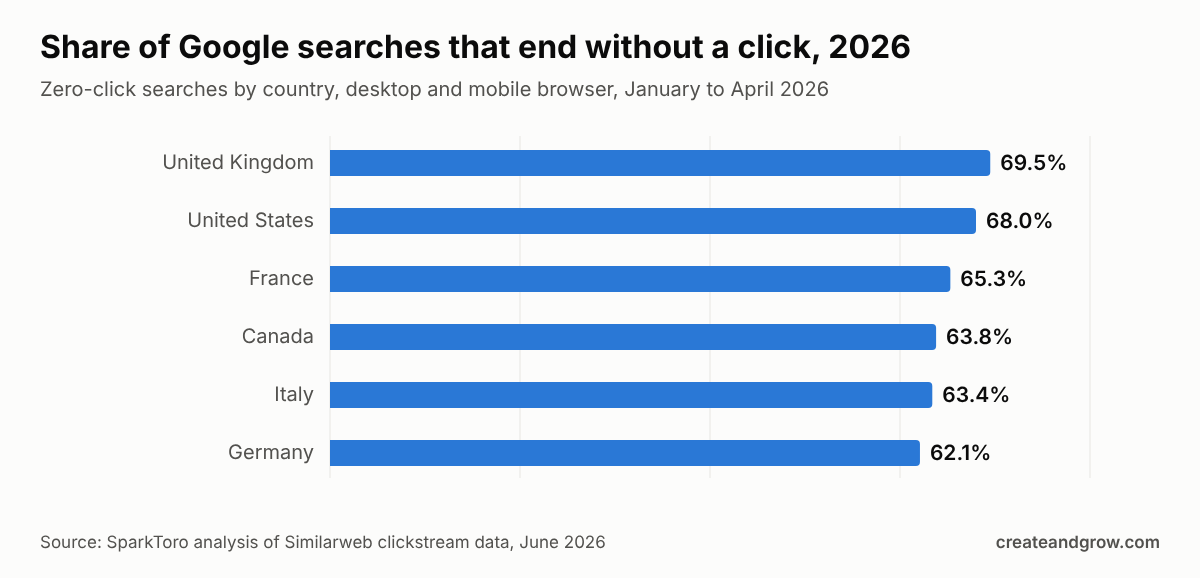
- The UK has the highest zero-click rate measured, at 69.5%; Germany has the lowest, at 62.1%. (Source: SparkToro)
- For every 1,000 Google searches in the US, only 231 clicks go to the open web. (Source: SparkToro)
- Google users click a traditional result on 8% of visits when an AI summary appears, versus 15% when it does not. (Source: Pew Research Center)
- AI Overviews correlate with a 58% lower click-through rate for the page ranking first. (Source: Ahrefs, 2026)
- Only 0.34% of Google searches went to AI Mode in early 2026, so its effect has barely started. (Source: SparkToro)
- Organic search still drives 42.75% of all website traffic, 134 times more than AI platforms. (Source: SE Ranking, 2026)
- Brands cited inside an AI Overview get 120% more organic clicks per impression than brands that are not cited. (Source: Seer Interactive)
How Many Searches End Without a Click?
SparkToro has tracked zero-click searches for years, using different clickstream panels. The panels are not identical, so treat the trend as directional, but the direction is clear.
| Year | Share of Google searches with no click | Data source |
|---|---|---|
| ~2016 | About 45% | Jumpshot panel |
| 2019 | 49% | Jumpshot panel |
| 2024 | 60.45% | Datos panel |
| 2026 (Jan to Apr) | 68.01% | Similarweb panel |
- The share of searches that lead to any click fell 9.51 points between 2024 and 2026, a 22.9% decline. (Source: SparkToro)
- The share of searchers who run another search instead of clicking rose 7.2 points over the same period. (Source: SparkToro)
- The data excludes the Google mobile app, where zero-click features are used even more, so the real rate is probably higher. (Source: SparkToro)
- In Ahrefs’ tracker of more than 75,000 websites, Google’s share of their traffic fell 8 points between June 2025 and May 2026, a drop of about 22%. (Source: SparkToro, citing Ahrefs)
Zero-Click Searches by Country
SparkToro repeated the analysis for five more countries with the same Similarweb panel and time period.
| Country | Zero-click searches | Clicks to the open web per 1,000 searches | Search session ends |
|---|---|---|---|
| United Kingdom | 69.5% | 232 | 43.1% |
| United States | 68.0% | 231 | 39.0% |
| France | 65.3% | 271 | 42.3% |
| Canada | 63.8% | 268 | 38.2% |
| Italy | 63.4% | 280 | 38.8% |
| Germany | 62.1% | 287 | 39.5% |
- German searchers click at rates more than 20% higher than UK searchers. (Source: SparkToro)
- No country measured still sends 300 or more clicks to the open web per 1,000 searches. (Source: SparkToro)
- US searchers are the most likely to search again instead of clicking (29.0%), compared with 22.5% in Germany. (Source: SparkToro)
- Between 7.3% and 9.4% of clicks go to Alphabet’s own sites, such as YouTube and Maps. (Source: SparkToro)
AI Overviews and Zero-Click Searches
The jump since 2024 lines up with the rollout of AI Overviews. Several independent studies show the same effect on clicks.
- AI Overviews now appear on more than 20% of Google searches and cut CTR by nearly 60% when present. (Source: SparkToro)
- Users end their browsing session on 26% of pages with an AI summary, versus 16% without one. (Source: Pew Research Center)
- Only 1% of visits to pages with an AI summary include a click on a link inside the summary. (Source: Pew Research Center)
- The CTR drop from AI Overviews is 58% for position one, 50.8% for position two and 19.4% for position ten. (Source: Ahrefs)
- Organic CTR on queries with an AI Overview hit a low of 1.31% in December 2025 before recovering to 2.36% in February 2026. (Source: Seer Interactive)
- Per million informational impressions, a page with no AI Overview gets about 33,500 clicks, a cited page about 20,700 and an uncited page about 9,400. (Source: Seer Interactive)
Our AI search statistics cover AI Overviews and AI Mode in more depth.
Zero-Click Beyond Google: AI Assistants
- AI platforms send just 0.32% of all website traffic, or about one visit in 312. (Source: SE Ranking)
- AI tools send less than 1% of traffic out, yet more than 20% of Americans use one ten or more times a month. (Source: SparkToro)
- At the discovery stage, 35% of US consumers rated AI tools as the most useful source, versus 13.6% for search engines. (Source: Similarweb, January 2026 panel)
- Paid results are taking a bigger share of the clicks that remain: in the headphones category, text ads and shopping ads went from 16% to 36% of all clicks in one year. (Source: Similarweb)
See our ChatGPT statistics and Perplexity and Claude statistics for how much traffic each assistant sends.
What Zero-Click Search Means for Your SEO
Fewer clicks do not mean search no longer matters. They mean visibility and traffic are no longer the same thing.
- Measure visibility, not just sessions. Track impressions, branded search volume and mentions in AI answers alongside traffic.
- Get cited, not just ranked. Seer’s data shows cited pages keep more than twice the clicks of uncited pages on the same query.
- Prioritise queries that still click. SparkToro notes that branded, local and high-intent transactional searches still send traffic.
- Be present where answers are built. AI answers draw from pages that rank and from sites that mention your brand, so earned mentions on trusted sites matter more than before.
Our zero-click SEO strategy guide turns these numbers into a plan. To see whether AI tools mention you, try one of the tools to track mentions in AI Overviews. If you want it done for you, see our AI search optimization service and brand mention campaigns.
Zero-Click Search FAQ
What is a zero-click search?
A zero-click search is a search that ends without the user clicking through to any website. The user either finds the answer on the results page, for example in an AI Overview or featured snippet, runs a new search, or leaves. In 2026, 68% of US Google searches were zero-click.
What percentage of Google searches are zero-click in 2026?
SparkToro’s analysis of Similarweb data found 68.01% of US Google searches ended without a click in January to April 2026. Rates in other countries ranged from 62.1% in Germany to 69.5% in the UK. The data excludes the Google app, so the true rate is likely higher.
Do AI Overviews cause zero-click searches?
They are the main driver of the recent increase. Pew found users clicked a traditional result on 8% of visits with an AI summary versus 15% without, and Ahrefs measured a 58% lower CTR for the top result when an AI Overview appears.
Is SEO still worth it with zero-click searches?
Yes. Organic search still drives 42.75% of all website traffic, according to SE Ranking, far more than any other channel. Ranking also feeds AI answers. The goal shifts from winning every click to being the brand that is cited and remembered.
Related Reading
