

Content marketing in 2026 is faster and cheaper to produce, but fewer marketers say it works. Only 13.9% of content marketers say their blog delivers strong results, an all-time low in Orbit Media’s 12-year survey, even though 92.4% now use AI to write.
The data points the same way across sources: AI saves time, but the teams still winning do the slower things, such as original research, expert collaboration and human editing. Here are the content marketing statistics for 2026, each linked to its original source.
- Top Content Marketing Statistics for 2026
- Is Content Marketing Still Working?
- AI in Content Marketing
- What Still Works in Content Marketing
- B2B Content Marketing Statistics
- What This Means for Your Content Plan
- Content Marketing Statistics FAQ
- Related Reading
Top Content Marketing Statistics for 2026
- Only 13.9% of content marketers say their blog delivers strong results, down from 26% in 2022. (Source: Orbit Media, 2026)
- 92.4% of content marketers use AI for blogging. (Source: Orbit Media)
- The average blog post is 1,312 words and takes 3 hours 20 minutes to write. (Source: Orbit Media)
- 97% of B2B marketers have a content strategy. (Source: Content Marketing Institute)
- 59% of B2B marketers rate their marketing as at least somewhat effective. (Source: Content Marketing Institute)
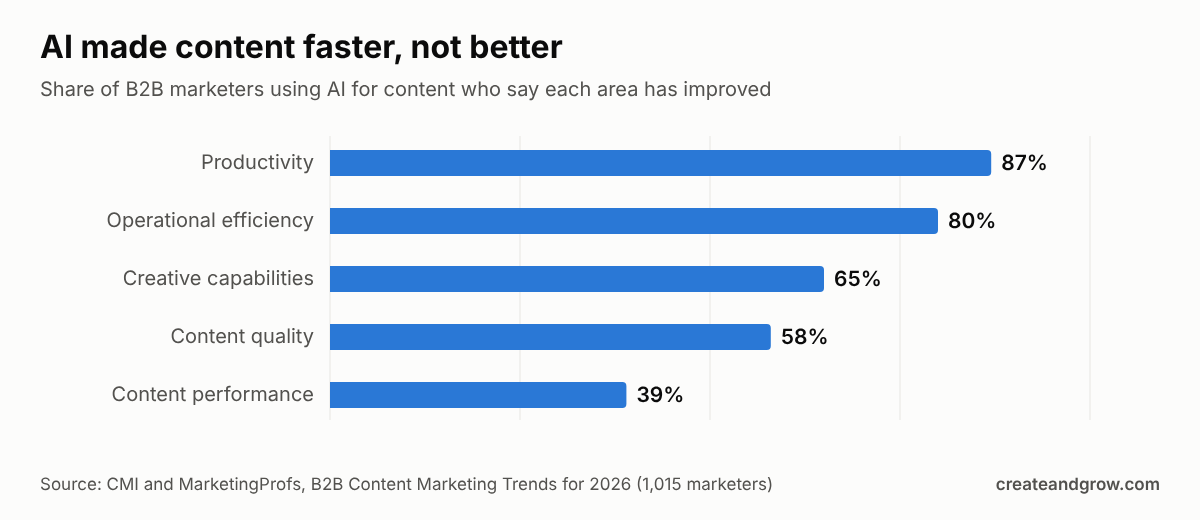
- 87% of B2B marketers using AI say productivity improved, but only 39% say content performance improved. (Source: Content Marketing Institute)
- 80% of marketers use AI for content creation, and 61% believe marketing is going through its biggest disruption in 20 years. (Source: HubSpot, 2026)
- Collaborating with influencers and experts is the strongest predictor of content success, at 2.6 times the benchmark. (Source: Orbit Media)
- Publishing original research raises the chance of strong results by about 50%. (Source: Orbit Media)
- LinkedIn is the most effective channel for B2B thought leadership (76%). (Source: Content Marketing Institute)
Is Content Marketing Still Working?
Orbit Media has asked more than 1,000 content marketers the same questions every year since 2014. For 12 years, 20% to 30% reported strong results. In 2026 that number fell sharply.
| Metric | 2026 | Earlier benchmark | Source |
|---|---|---|---|
| Bloggers reporting strong results | 13.9% | 26% in 2022 | Orbit Media |
| Bloggers who don’t know if it works | 18% | 9% to 14% for a decade | Orbit Media |
| Average blog post length | 1,312 words | 1,427 words in 2023 (peak) | Orbit Media |
| Average time to write a post | 3 h 20 min | 4 h 10 min in 2022 (peak) | Orbit Media |
- The average content marketer now spends about 50 fewer hours a year writing than in 2022. (Source: Orbit Media)
- Marketers publishing two to six times a week fell from 28% in 2014 to 12% in 2022, while monthly publishing doubled. (Source: Orbit Media)
- The B2B picture is more positive: 12% say their marketing was highly effective, 47% somewhat effective and 31% neutral. (Source: Content Marketing Institute)
- Enterprise marketers do better, with 68% rating their marketing as effective. (Source: Content Marketing Institute)
- 61% of B2B marketers say their content strategy improved over the past year, and 74% of them credit strategy refinement. (Source: Content Marketing Institute)
Part of the drop is a measurement problem. With 68% of Google searches ending without a click, content can influence buyers without sending a visit. See our zero-click search statistics.
AI in Content Marketing
- 95% of B2B marketers say their organisations use AI-powered applications. (Source: Content Marketing Institute)
- 89% of those use AI to generate or optimise written content, and 53% use it for images and video. (Source: Content Marketing Institute)
- 12% of B2B marketers say AI has made their content quality worse. (Source: Content Marketing Institute)
- 68% of B2B marketers are still exploring or developing their AI approach; only 8% call it advanced or leading. (Source: Content Marketing Institute)
- 28% experiment with AI agents, but only 3% say agents are core to their strategy. (Source: Content Marketing Institute)
- AI users and non-users are equally likely to report strong blogging results, but non-users are more likely to report disappointing ones. (Source: Orbit Media)
- 75% of marketers use AI for media production. (Source: HubSpot)
For the tools themselves, see our roundup of AI content writing tools and our generative AI statistics.
What Still Works in Content Marketing
Orbit Media’s data shows that the tactics most linked to strong results are the ones marketers have cut back on.
- Influencer and expert collaboration beats the strong-results benchmark by 2.6 times, yet only 7% of marketers do it, down from 25% in 2017. (Source: Orbit Media)
- Original research improves the likelihood of strong results by about 50%. (Source: Orbit Media)
- Marketers using six or more of the eight tactics Orbit tracks are nearly three times as likely to report strong results; none of the 1,042 respondents use all eight. (Source: Orbit Media)
- Content with a formal human editing process performs better than content edited only by AI. (Source: Orbit Media)
- Effective B2B teams credit content relevance and quality (65%), team skills (53%) and alignment with sales (45%). (Source: Content Marketing Institute)
Original research is also what earns links and AI citations. Our digital PR statistics show 95.9% of digital PRs pitch data-led content, and our guide to link magnets covers formats that attract links.
B2B Content Marketing Statistics
- The top content challenges are creating content that drives action (40%), resource constraints (39%) and measuring effectiveness (33%). (Source: Content Marketing Institute)
- 96% of B2B marketers create thought leadership content, but 37% say fewer than 5% of their experts contribute. (Source: Content Marketing Institute)
- The most effective channels for thought leadership are LinkedIn (76%), email newsletters (54%) and events or webinars (52%). (Source: Content Marketing Institute)
- Marketers measure thought leadership mainly by engagement (80%) and business impact such as leads and pipeline (63%). (Source: Content Marketing Institute)
- 91% of B2B marketers collect first-party data, mostly through subscriptions, communities and loyalty programmes (77%). (Source: Content Marketing Institute)
- 78% of B2B marketers allocate budget to experiential marketing such as events. (Source: Content Marketing Institute)
For more B2B numbers, see our B2B marketing statistics and blogging statistics.
What This Means for Your Content Plan
- Use AI for speed, not for the whole job. The teams seeing results keep human editing and add expert input.
- Publish something only you can publish. Original data and first-hand experience are what AI tools and journalists cite.
- Promote beyond your blog. LinkedIn, newsletters, webinars and coverage on other sites now do more than a post on its own.
- Measure more than traffic. Track leads, branded search and mentions in AI answers, since many readers never click.
If you want content that earns links and mentions, our SEO content writing service and digital PR service are built around this approach.
Content Marketing Statistics FAQ
Is content marketing still effective in 2026?
For B2B, mostly yes: 59% of marketers rate their marketing as at least somewhat effective, according to CMI. But only 13.9% of bloggers report strong results in Orbit Media’s survey. The gap comes from tactics: research, expert collaboration and editing still work, while thin AI content does not.
How long should a blog post be in 2026?
The average blog post is 1,312 words and takes 3 hours 20 minutes to write, according to Orbit Media. Length alone does not drive results. Effort, visuals, original data and expert input are more closely linked to performance than word count.
How many marketers use AI for content?
Most of them. 92.4% of content marketers use AI for blogging (Orbit Media), 95% of B2B organisations use AI-powered applications (CMI) and 80% of marketers use AI for content creation (HubSpot). Most report productivity gains, but only 39% see better content performance.
Related Reading
