97% of US consumers read online reviews before choosing a local business, and 45% now ask ChatGPT or another AI tool for local recommendations, up from 6% a year earlier, according to BrightLocal’s Local Consumer Review Survey 2026.
Google is still where most local searches start, but customers check more places, decide faster and expect more from reviews than ever. The local SEO statistics below cover search behaviour, reviews, AI recommendations and ranking factors. Every figure links to its original source.
- Top Local SEO Statistics for 2026
- How Consumers Search for Local Businesses
- How Fast Customers Decide
- Online Review Statistics for Local Businesses
- Review Response Statistics
- Fake Review Statistics
- AI and Local Search Statistics
- Local AI Search Visibility Factors
- What These Local SEO Statistics Mean for Your Business
- Local SEO Statistics FAQ
- Related Reading
Top Local SEO Statistics for 2026
- 84% of US consumers searched online for a local business in the last three months. (Source: BrightLocal, July 2026)
- 61% start a local search on Google: 52% on Google Search and 9% on Google Maps. (Source: BrightLocal)
- 73% of local searches happen on a mobile phone. (Source: BrightLocal)
- 97% of consumers read online reviews for local businesses, and 41% always read them, up from 29% in 2025. (Source: BrightLocal LCRS 2026)
- 45% of consumers use ChatGPT or other AI tools for local recommendations, up from 6% a year earlier. (Source: BrightLocal LCRS 2026)
- 68% need a business to have at least four stars before they use it, up from 55% in 2025. (Source: BrightLocal LCRS 2026)
- 47% will not use a business with fewer than 20 reviews. (Source: BrightLocal LCRS 2026)
- 75% of consumers decide which local business to contact in under 30 minutes. (Source: BrightLocal Consumer Search Behavior 2026)
- Being featured on expert-curated “best of” lists is the top factor for local AI search visibility, according to 47 local SEO experts. (Source: Whitespark 2026)
- Only 68% of business contact details shown on ChatGPT and Perplexity match the Google Business Profile. (Source: SOCi Local Visibility Index 2026, via BrightLocal)
How Consumers Search for Local Businesses
BrightLocal surveyed 1,227 US consumers who had searched for a local business in the previous three months.
| Where the search started | 2025 | 2026 |
|---|---|---|
| Google Search | 45% | 52% |
| Google Maps | 15% | 9% |
| Google in total | 60% | 61% |
- 71% used Google at some point while looking for a local business. (Source: BrightLocal)
- 75% used more than one channel before choosing a business. (Source: BrightLocal)
- Besides Google, 30% used social media, 23% used AI tools and 19% used review sites during the search. (Source: BrightLocal)
- Mobile accounts for 73% of local searches, computers for 19% and tablets for 8%. (Source: BrightLocal)
- Mobile use peaks at 86% for 30 to 44 year olds and is lowest among people over 60, at 57%. (Source: BrightLocal)
- 33% of consumers who started on Google finished their search there without checking anywhere else. (Source: BrightLocal)
Our SEO statistics cover the wider search market, and the zero-click search statistics show why many local searches end on the results page.
How Fast Customers Decide
- 75% of consumers choose which local business to contact in under 30 minutes, and 28% decide in under five minutes. (Source: BrightLocal Consumer Search Behavior 2026)
- 72% look at three businesses or fewer before deciding; just 1% look at more than ten. (Source: BrightLocal)
- The top reasons to contact a business are clear, complete information (32%), the best or most reviews (30%) and clear pricing (29%). (Source: BrightLocal)
- 65% of the reasons consumers give for rejecting a business are related to reviews. (Source: BrightLocal)
- 96% say it is important for a business to actively manage its online presence, and 33% call it essential. (Source: BrightLocal)
Online Review Statistics for Local Businesses
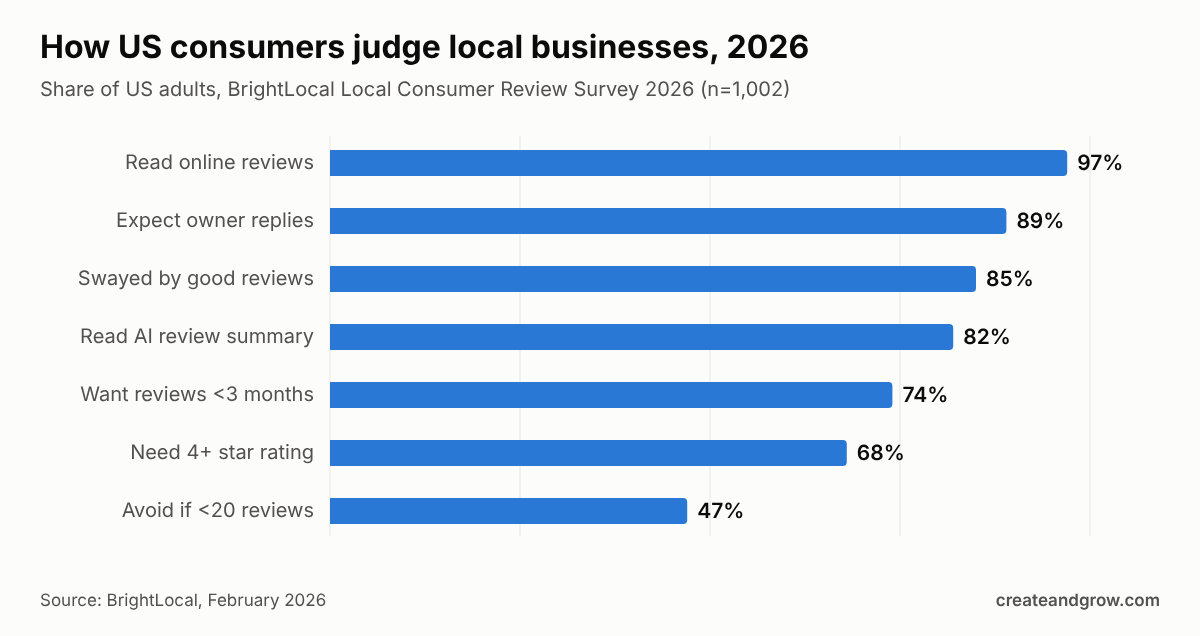
BrightLocal’s annual review survey of 1,002 US adults, published in February 2026, shows consumers have raised the bar on ratings, review counts and freshness.
Ratings and review volume
| Minimum star rating needed | 2025 | 2026 |
|---|---|---|
| 4 stars or higher | 55% | 68% |
| 4.5 stars or higher | 17% | 31% |
| 5 stars only | n/a | 10% |
- 92% of consumers pay attention to star ratings. (Source: BrightLocal)
- 47% will not use a business with fewer than 20 reviews, and only 9% would use one with five or fewer. (Source: BrightLocal)
- 74% want to see reviews written in the last three months; 32% want reviews from the last two weeks, up from 20%, and 18% want them from the last week. (Source: BrightLocal)
- The average consumer uses six different review sites. (Source: BrightLocal)
What reviews make customers do
- 85% are more likely to use a business after reading positive reviews, and 77% are put off by negative ones. (Source: BrightLocal)
- After reading positive reviews, 54% visit the business website (32% in 2019), 66% research further, 31% visit the location and 34% buy or book. (Source: BrightLocal)
- 93% have bought something after reading reviews; 27% spent more than $1,000 and 13% more than $5,000. (Source: BrightLocal)
- 70% have regretted a purchase made after reading reviews, and 14% regretted spending more than $1,000. (Source: BrightLocal)
Where people read reviews
- Google is used for reviews by 71% of consumers, down from 83% in 2025. (Source: BrightLocal)
- Apple Maps grew from 14% to 27%, while local news sites fell from 48% to 29%. (Source: BrightLocal)
- Instagram (37%) and TikTok (29%) are now used as review platforms too. (Source: BrightLocal LCRS 2026)
Review Response Statistics
- 89% of consumers expect businesses to respond to reviews. (Source: BrightLocal)
- 80% are likely to use a business that responds to all its reviews, while 42% are unlikely to use one that never replies. (Source: BrightLocal)
- 19% expect a reply on the same day, up from 6% a year earlier, and 32% expect one by the next day, up from 18%. (Source: BrightLocal)
- 81% expect a response within a week. (Source: BrightLocal)
- 50% are put off by replies that look templated. (Source: BrightLocal)
Getting more reviews
- 69% of consumers wrote a review for a local business in the last 12 months, and 94% are open to doing so. (Source: BrightLocal)
- 78% were asked by a business to leave a review, and 83% of those who were asked left one. (Source: BrightLocal)
- 28% always leave a review when asked, up from 16% in 2025. (Source: BrightLocal)
- Google is the most popular place to write a review (45%), followed by Facebook (34%), Yelp (24%) and Apple Maps (17%). (Source: BrightLocal)
Review monitoring and request tools are covered in our list of the best local SEO tools.
Fake Review Statistics
- 97% of consumers think businesses that post fake reviews should be punished. (Source: BrightLocal)
- 57% want those businesses banned from review platforms, and 46% want them removed from Google. (Source: BrightLocal)
- 63% say review platforms are responsible for stopping fake reviews. (Source: BrightLocal)
AI and Local Search Statistics
AI assistants have become a real local discovery channel in one year, but most people still check Google before they call.
- 45% of consumers used ChatGPT or other AI tools for local recommendations, making AI the third most popular source, up from 6% a year earlier. (Source: BrightLocal LCRS 2026)
- 31% use AI tools at least monthly to find local businesses, while 19% say they would not use them at all. (Source: BrightLocal)
- Only 18% of AI users were ready to contact the business the AI recommended. (Source: BrightLocal)
- Of consumers who started a local search with AI, just 2% used only AI; 43% checked Google and 39% checked social media. (Source: BrightLocal)
- 40% trust AI recommendations for local businesses (32% do not), and 42% trust them as much as reviews. (Source: BrightLocal)
- 82% read AI-generated review summaries, and 23% would rely on the summary alone. (Source: BrightLocal)
- Being recommended by ChatGPT is 30 times harder than appearing in Google’s local results. (Source: SOCi Local Visibility Index 2026, via BrightLocal)
- Businesses recommended by AI average 4.3 stars on ChatGPT, 4.1 on Perplexity and 3.9 on Gemini. (Source: SOCi, via BrightLocal)
For the bigger picture, see our AI search statistics and ChatGPT statistics.
Local AI Search Visibility Factors
Whitespark’s 2026 Local Search Ranking Factors survey, published in November 2025, asked about 47 local SEO experts to rate what drives visibility in AI search. These are expert opinions, not measured correlations.
| Rank | Factor for local AI search visibility | Score |
|---|---|---|
| 1 | Presence on expert-curated “best of” lists | 179 |
| 2 | A dedicated page for each service | 170 |
| 3 | Prominence on key industry websites | 167 |
| 4 | Quality of unstructured citations (news, blogs) | 160 |
| 5 | Authority of third-party review sites | 156 |
| 6 | Geographic keyword relevance | 153 |
| 7 | Number of unstructured citations | 147 |
| 8 | High Google ratings | 146 |
| 9 | Niche focus | 138 |
| 10 | Scannable content structure | 137 |
Four of the top seven factors depend on what other websites say about the business. That is why brand mentions on trusted sites and inclusion in “best of” lists now matter for local businesses, not only national brands.
What These Local SEO Statistics Mean for Your Business
- Keep your Google Business Profile complete. Clear information is the top reason people contact a business, and AI tools copy contact details from it.
- Ask every customer for a review. 83% of people who are asked leave one, and freshness now matters to three in four consumers.
- Reply to every review quickly and in your own words. Same-day reply expectations tripled in a year, and templated replies put half of consumers off.
- Build a page for each service. Experts rank dedicated service pages as the second most important factor for local AI visibility.
- Get onto “best of” lists and industry sites. Off-site mentions drive AI recommendations more than anything on your own site.
Some examples: our guide to SEO for carpet fitters shows how a local trade business can apply these steps, and our schema markup generator creates LocalBusiness markup for free. If you want help getting cited by AI tools, see our AI search optimization service.
Local SEO Statistics FAQ
What percentage of consumers read online reviews for local businesses?
97% of US consumers read online reviews when choosing a local business, according to BrightLocal’s Local Consumer Review Survey 2026, and 41% say they always read them. Reviews are also the most common reason people reject a business, behind 65% of rejections.
Where do most local searches start in 2026?
Google. BrightLocal found 52% of US consumers started on Google Search and 9% on Google Maps, so 61% began on Google. Most people also check other channels, with 75% using more than one, including social media, AI tools and review sites.
Do people use ChatGPT to find local businesses?
Yes, and fast-growing. 45% of US consumers used ChatGPT or other AI tools for local recommendations in 2026, up from 6% a year earlier. Most still verify the answer: only 2% of people who started with AI relied on it alone.
How many reviews does a local business need?
At least 20 is a good first target. BrightLocal found 47% of consumers will not use a business with fewer than 20 reviews, and 74% want to see reviews from the last three months, so a steady flow matters as much as the total.
Related Reading